Service management that runs with the work, not parallel to it.

The Atlassian Service Collection, configured to how your business runs. Accelerate services from IT to business teams. Deployed in days, not months.

You bought the platform .
Now maximize it.

Six months after adopting Jira, is Rovo driving workflows? Are Confluence answers hidden? Let's step you up.

Service desk built generic.

Service desk built generic.

Templates from another team landed in your instance. Your team works around the config, not inside it.

Rovo agents sit idle.

Rovo agents sit idle.

Rovo on the bill. No agents designed for your workflows. The team keeps doing the work by hand.

Assets never configured.

Assets never configured.

CMDB still scoped as a Phase 2 project. Agents resolve tickets without seeing the infrastructure they own.

Knowledge buried and siloed.

Knowledge buried and siloed.

Confluence has the answers. Tickets still come in because nothing connects the knowledge to the portal.

Service Ops that don't stay in IT.

AI INTELLIGENCE · ROVO

Agents that act on your real incidents.

Rovo agents read your incident model, surface Confluence answers, and act on your asset graph.

SERVICE DESK · Jira Service Management

Service desk shaped to your operation.

One engine for IT, HR, Finance, Legal, Facilities, Procurement, and customer service. Configured per team.

CONFIGURATION · ASSETS

Every ticket arrives with infrastructure attached.

Decisions, specs, and knowledge structured for findability and connected to the work in Jira, so the why stays with the what.

KNOWLEDGE · CONFLUENCE

Answers deflect before tickets open.

Articles surface in Jira Service Management, in Rovo’s responses, and the portal. Deflection happens.

Built from how
you actually operate.

Phased, smart, and rapid. Enjoy Rapid Deploy, Trundl's contextual delivery model.

01

Context, captured

We read your service desk: incident model, approvals, SLAs, knowledge, audit posture.

02

Built to fit

We build the service desk to fit. Jira Service Management, Assets, Rovo, Confluence shaped to your workflows.

03

Kept in step

Your other tools, kept aligned with Jira.

Discovery in hours. Testing in days . Full working solutions each week.

Trundl brings unique delivery technology built to drive changes as fast as your business needs it.

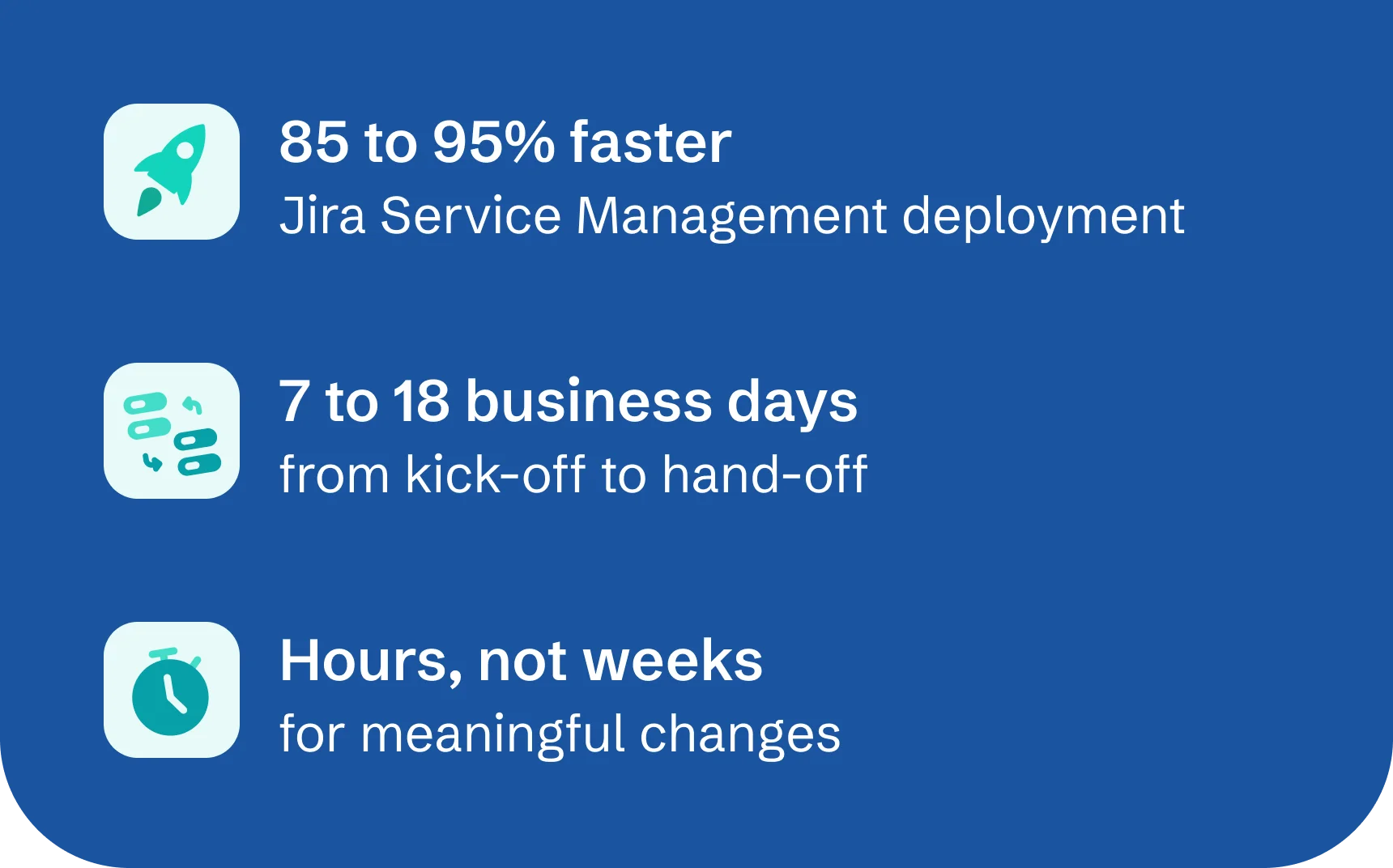
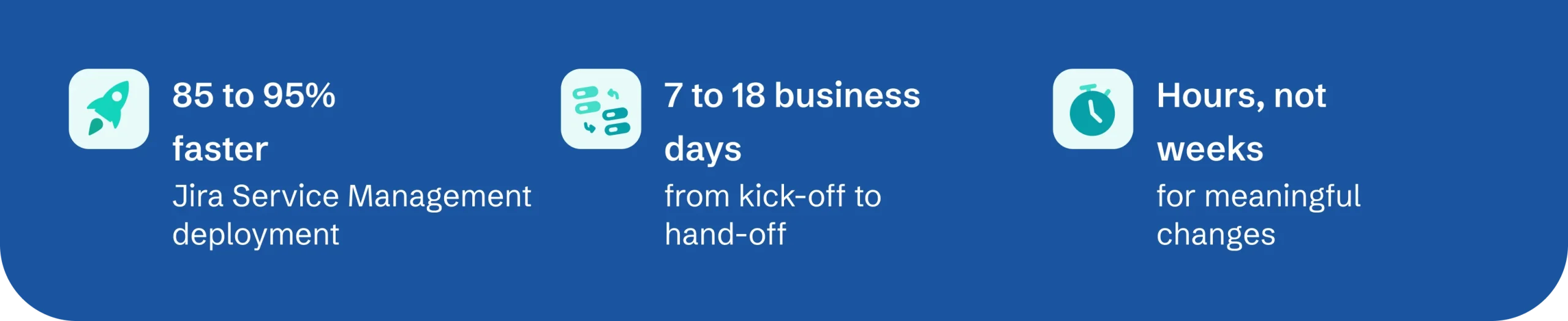
85 to 95%

faster than traditional implementation

7 to 18

business days to first live team

95%

renewal rate across the engine

Hours, not weeks

build cycles

Days 1-2

The whole service operation gets read in the workshops. Use cases identified. Audit posture mapped.

Days 2-7

The first service portals, queues, and critical workflows are test-ready, with Agents and Assets included.

Days 7-10

Guaranteed live solution hand-off, with post-deployment support and training built in.

Scale at Speed

Scale the Atlassian system of work to more teams.

Start with IT . Add teams in series . Same Rapid Deploy engine.

Fixed packages. Guaranteed timelines. Fixed price.

What's in the room with us.

Two of your IT operators plus the team leads of the workflows that matter.

Validated phase by phase.

Rapid build test phases. IT lands first. The next team in series, days each. Validated by the team using it.

What you operate after.

A working service desk on Atlassian. Your team runs it from cutover. Admins iterate from there.

Thirty minutes. Your service desk. Our practice.

Book a Jira Service Management scoping call. Walk us through your current service model and what’s not getting deployed today. We come back inside the week with a phased implementation plan and a fixed-price scope.

First scoping call inside the week.

Latest from Trundl.

The Accelerated Contextual Delivery whitepaper.

The definitive guide to Accelerated Contextual Delivery. Eight pages. Built for CIOs, CTOs, and VPs of platform strategy.

The Bioventus story

How a healthcare technology team rebuilt the way they run work in Jira.

Built for your teams, not a template

Why your Jira should be configured around how your teams deliver, not a default layout.

Before you book a meeting.

What does an ITSM & ESM engagement look like, week by week?

Each engagement runs in two-week sprints. Sprint 0 maps your operating reality: existing tool, workflows, SLAs, integrations. Sprints 1 through 3 build the JSM instance. The final sprint is handoff. Your project owner attends every sprint review from week one.

ITSM handles IT incidents, service requests, and changes. ESM extends the same discipline to HR, facilities, legal, and finance. Same JSM platform underneath, department-scoped portals, shared reporting layer. Most ITSM engagements expand to ESM scope inside twelve months.

Yes. The migration approach maps every configuration in the old system to its JSM equivalent first. Workflows are rebuilt for how JSM is built, with parallel-run validation. A 28-campus institution moved off ServiceNow with a 38% licensing reduction.

A new build is three to six weeks. A replacement is six to ten weeks depending on scope and integration depth. An optimization sprint is two to four weeks. Every engagement is scoped and priced before work begins, so the timeline is locked at kickoff.

ACD is the category Trundl pioneered: enterprise platform delivery built for the AI era. Rapid Deploy is the engine that runs it. For service management, that means Discovery reads existing workflows, Deployer builds JSM, and Sync handles migrations. Engine plus framework.

Only if you want it. The default engagement ends at handoff. Your team runs JSM from go-live. An optional run-state tier exists for teams that prefer ongoing tuning, but most customers don’t need one. Knowledge transfer happens during the build.

Trundl is ISO 27001:2022 certified, SOC 2 Type II compliant, GDPR aligned, and HIPAA-aligned for healthcare engagements. JSM configurations include access controls, audit trails, and governance built into the first build. Compliance posture documented in the Trust Center.

Integrations are scoped during Sprint 0 and built into the JSM configuration during the build sprints. Common patterns include ticket creation from chat, request approvals routed to Slack or Teams, and Salesforce case sync. Each integration scoped against your operating reality.

Knowledge transfer happens during the build. Documentation, runbooks, agent training, and admin training are part of every engagement. By the final sprint, your team runs the instance with us watching. The optional run-state tier exists for teams that want extra hand-holding.

JSM is the Atlassian product. ITSM is the practice of managing IT services on a platform like JSM. ESM extends that same service-management discipline to non-IT departments. Trundl deploys all three flavors on a single JSM instance.