- AI²
All of your AI. One governed system.
AI² gives every model a boundary and a job, every output an owner, and every contribution an audit trail. Rapid Deploy delivers the platform in days.
Fast-track value through Rapid Deploy.
Months to Weeks
Months to Weeks
AI sprawl to
Governed System
AI sprawl to Governed System
Personal Productivity to Production Execution
400+ enterprises trust the engine.
Built for the multi-model reality: platform AI plus the assistants your teams already use.
Every model gets a lane.
In-workflow AI that answers from your environment.
Platform AI handles in-context work inside Jira and Confluence: retrieval, summarization, ticket-level assistance. Trundl configures the agents and strengthens the knowledge they answer from.
WHAT THE CONFIGURATION COVERS
- Context retrieval from the Jira and Confluence you already run
- Knowledge quality improved as part of the rollout
- Permissions and boundaries set by your policies
Your approved assistants work inside the system of record.
Approved assistants, Claude, ChatGPT, or Copilot, connect through governed access layers like the Atlassian MCP server and take the cross-context reasoning and transformation work.
WHAT THE CONFIGURATION COVERS
- Access limited to approved models and named data sources
- Permissions mirrored from your platform roles
- Full audit trail on every AI-initiated contribution
A platform agents can act on safely.
Rapid Deploy is the enforcement mechanism. Workflows, routing, and permissions hold before any agent acts.
A platform agents can act on safely.
Rapid Deploy is the enforcement mechanism. Workflows, routing, and permissions hold before any agent acts.
WHAT THE CONFIGURATION COVERS
- Working configuration in 7 to 18 business days
- Workflows, routing, and permissions configured first
- Scope and timeline fixed before any agent acts
Governed for the audits you already answer to.
Industry-tuned patterns for regulated engineering organizations.
Healthcare Technology
PHI is masked before any model sees it. Sign-off stays human at regulated decision points. Audits reconstruct input, output, and decision.
Manufacturing
AI-assisted documentation carries full attribution in Jira and Confluence, so ASPICE and ISO 26262 reviews pull evidence from the system of record.
Healthcare Technology Company
AI² turns escalation from a coordination project into a workflow.
A documented Healthcare Technology reference pattern: an owner and an AI role at every stage.
1
workflow
5
use case patterns in the starting scope
2
ready to compose AI layers
7 to 18 days
one audit trail
Every stage
to a working configuration
Day 0
Escalation lands. AI structures the report, environment, and history into one record. Support owns the submission.
Hour 1
AI drafts the package with reproduction steps. Support reviews before it moves.
Hour 2
AI suggests the routing. Support approves. The decision is logged for audit.
Day 1+
Engineering receives a standardized package, AI contributions logged per stage. Engineering owns the diagnosis.
Trundl’s job isn’t to follow a platform roadmap. It’s to arrive ahead of it, operationalize what’s possible, and deliver outcomes where it counts: in the workflows that drive how work gets done.
Manohar Goli
CTO, Trundl
Twelve hours.
A scoped AI² engagement.
Bring one workflow where AI is already in use. Trundl returns the assessment, the configuration, and the timeline.
Format
Remote, on-site, or hybrid
Duration
12 hours, one or two days
Participants
Trundl architects + your platform owner, security lead, and one workflow owner
You Receive
Current-state assessment, scoped configuration, timeline
Send the list of AI tools your teams use today. Rapid Deploy comes ready to build.
Latest from Trundl.
The Case for Contextual Delivery
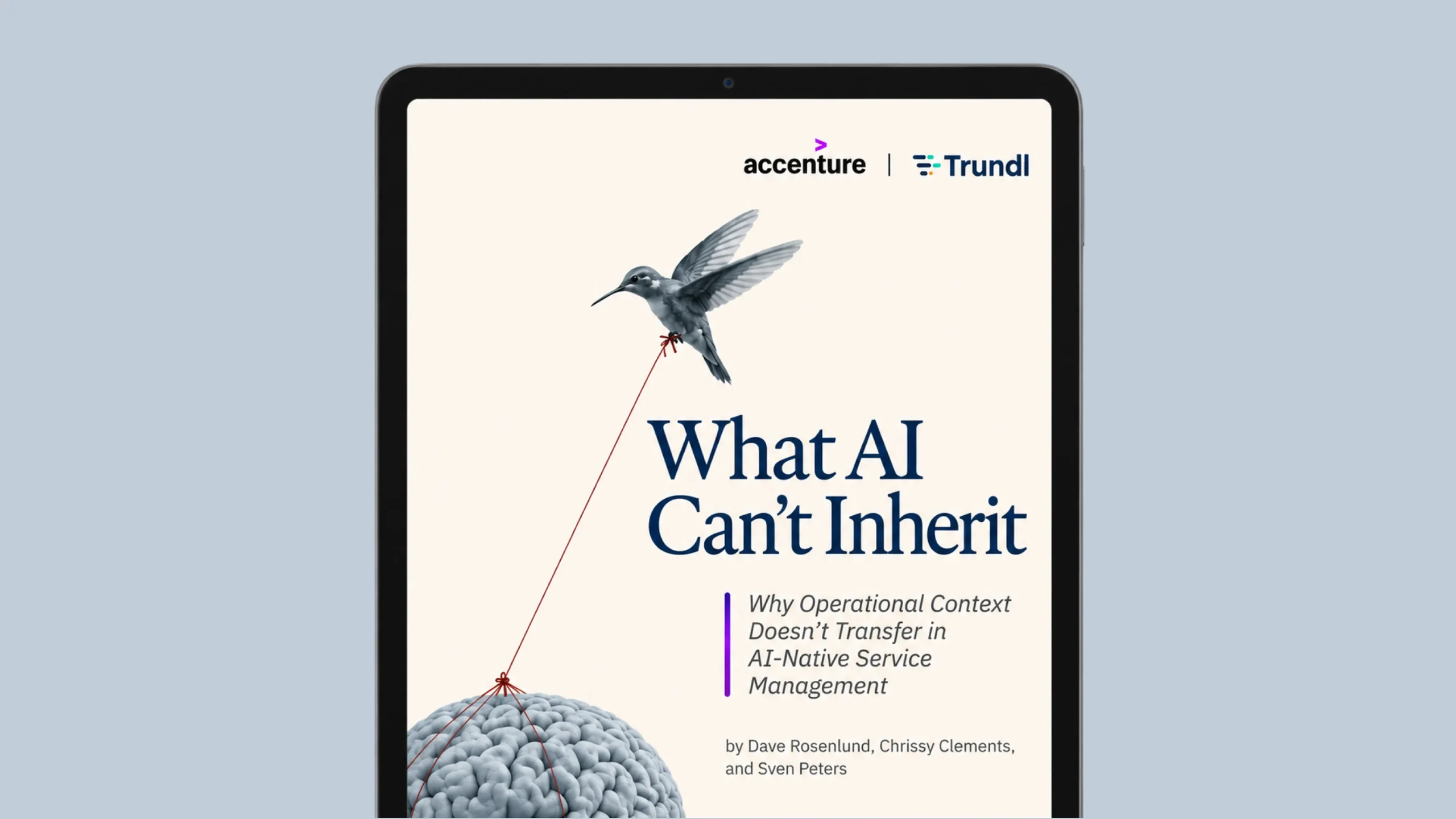
The definitive guide to Accelerated Contextual Delivery. Eight pages. Built for CIOs, CTOs, and VPs of platform strategy.
Common questions.
What is AI²?
AI² is Trundl’s composable solution for operationalizing AI as a system capability instead of a collection of tools. It aligns the models you already run, your workflows, and your governance controls into one execution layer, delivered through Rapid Deploy in days.
What does the ² in AI² mean?
The first AI is the capability: reasoning, generation, and transformation. The second AI is the execution layer: the workflows, orchestration, governance, and model alignment that make the capability usable in practice. AI is the capability. AI² is the system that makes it work.
Should we use Rovo or an external AI like ChatGPT, Claude, or Copilot?
Usually both, in designed lanes. Rovo handles in-context workflow assistance inside Jira and Confluence: retrieval, summarization, and ticket-level help. Approved external models handle cross-context reasoning and transformation. AI² designs how they operate together, because most organizations already run more than one.
Do we have to standardize on one AI platform?
No, and AI² assumes you won’t. Organizations operate in multi-model environments, and that is the operating reality rather than a transitional phase. AI² gives each model a boundary and a job under shared governance, so the mix can evolve without rework. Where one model is enough, AI² runs with one.
Who owns the output when AI helps produce it?
A named person at every stage, by design. AI assists; humans remain accountable for outputs. AI² maps ownership across each AI-assisted workflow: support owns intake accuracy, engineering owns diagnosis, and every approval point is explicit before the first agent acts.
How does AI² handle governance?
Governance is configured before capability. AI² defines where AI is allowed and restricted, sets approval checkpoints and human-in-the-loop expectations, aligns to your existing AI policies, and monitors usage drift. Every AI contribution carries a trace in the system of record.
How does AI² connect external AI tools to our systems?
Through governed access layers such as the Atlassian MCP server. Approved models connect to named data sources with permissions mirrored from your platform roles, so AI that ran in side channels moves into the system of record with a full audit trail.
What are the first AI² use cases to deploy?
Five patterns repeat across engagements: a knowledge assistant answering from validated content, AI triage and routing of incoming work, summarization and handoff between teams, an operations copilot working within defined boundaries, and a reporting layer that surfaces bottlenecks. Each is piloted in a real workflow, then expanded.
How does AI² handle PHI and sensitive data?
As hard constraints. No PHI reaches an external model unless explicitly approved, sensitive fields are masked before AI processing, and boundaries are defined per workflow step. Audit readiness means being able to reconstruct the input, the AI output, and the human decision.
Does AI governance slow teams down?
No. The boundaries live in the platform configuration, so enforcement is automatic rather than procedural. Approvals happen inside the workflow, agents act within pre-set permissions, and side-channel work stops needing to be rebuilt in the system of record after the fact.
Is AI² an AI product we have to buy?
No, and there is nothing new to license. AI² designs, configures, and governs the AI you already have: your platform’s AI plus your approved external models, embedded into working systems through Rapid Deploy.
Do we have to use Atlassian for AI²?
AI² is platform-agnostic by design and anchored in Atlassian today, where workflows in Jira, knowledge in Confluence, and platform AI are already central to execution. Engagements typically start in the Teamwork Collection and extend into Service and Software Collections as use cases grow.
How long does an AI² engagement take?
The governed platform configuration lands in 7 to 18 business days through Rapid Deploy. The first use case is piloted in a real workflow, validated, then expanded. Starting scope is deliberately one or two high-friction workflows, not an enterprise AI strategy exercise.
What does an AI² engagement cost?
AI² is priced on outcomes, not hours: fixed packages scoped to the workflows and models in play. Because the solution is composable, the Discovery Workshop sizes the engagement to your estate and returns a fixed scope and timeline before you commit.
How is AI² different from Microsoft Copilot Enablement?
Copilot Enablement is an expert-led Trundl service for rolling out Copilot across Microsoft 365. AI² is broader: it governs multiple AI systems working together inside your delivery and service workflows, with ownership and audit designed in. Many organizations run both.
What about model lock-in?
AI² is AI-agnostic by design. Boundaries, permissions, and audit live in your platforms and workflows rather than in any one vendor’s model, so models can be swapped as your approved list evolves. The system of work is the durable asset.
Which industries does AI² support?
Trundl’s go-to-market focus is Healthcare Technology and High-Tech Manufacturing, where AI touches regulated workflows and audits follow. The underlying model is industry-agnostic and composable: the same system, tuned to each industry’s constraints, risk models, and operating patterns.
When is AI² not the right fit?
If no AI is approved for use in your organization yet, or the goal is a single-team productivity pilot with no governance requirement, AI² is more system than you need. Trundl takes engagements where the outcome can be scoped, validated, and guaranteed.