Extend your Atlassian platform.

Secure, production-grade apps running inside Atlassian's platform.

Trundl's development team knows Atlassian and innovates through Atlassian.
Our experience, your IP.

Forge specialization, behind 450+ enterprises that trust the engine .

Sound familiar?

Three patterns show up in every Forge assessment we run.
If any of these is yours, the rest of this page is for you.
THE 80% APP

The marketplace app does 80%. The rest is work-arounds.

Custom scripts, manual JSON imports, and a Confluence page nobody updates. Every quarter, the gap between the marketplace app and the actual workflow widens.
THE CONNECT REVIEW

Every release of your Connect app dies in security review for three weeks.

Your team built it. Your team hosts it. Your team owns the compliance burden. Every release re-litigates the same security questions.
THE PTO RISK

One person built the script that holds it together. That person has PTO next week.

The integration works. Nobody else can read the code. The Slack ping when it breaks goes to a single Gmail address. The risk is invisible until it isn’t.

What changes after the Forge build.

They become properties of the platform.

Your users stop noticing.

Your users stop noticing.

Forge apps run inside Atlassian. Same UI. Same permissions. Same data residency. Indistinguishable from native. The training email you used to send for every release stops being necessary.

Security review stops being a project.

Security review stops being a project.

SOC 2, GDPR, and your internal policies are in the runtime. Teams that used to lose three weeks per release clear review on the first pass. Compliance is inherited, not built.

The timeline shrinks.

The timeline shrinks.

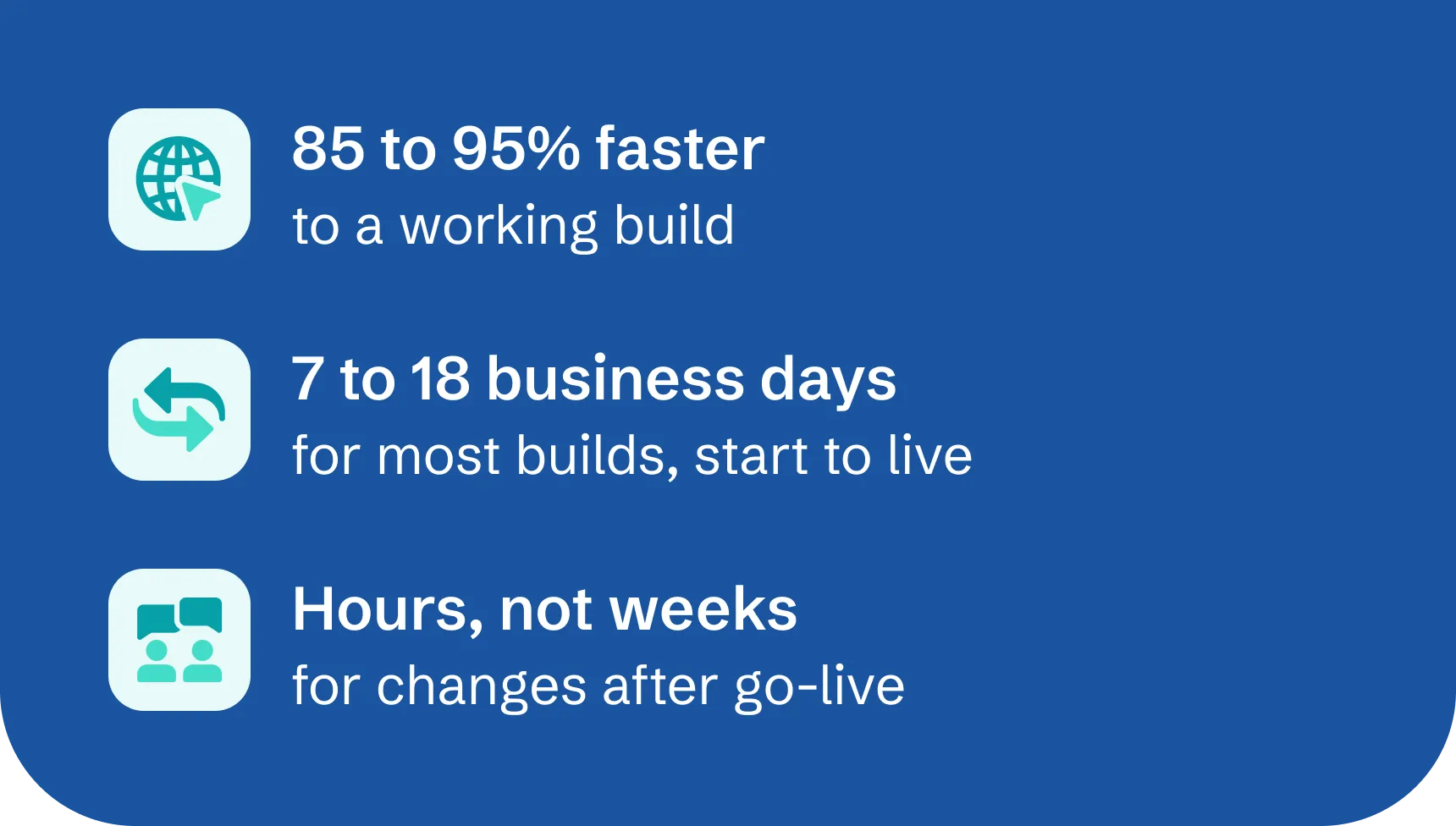
Rapid Deploy methodology. Fixed scope. Defined timeline. Four-to-eight weeks from kickoff to production. The same engagement on Connect runs four to eight months.

The 2 am pages stop.

The 2 am pages stop.

One Atlassian-managed runtime replaces your fragile APIs, aging Connect apps, and undocumented scripts. Atlassian patches the platform. Your team patches their logic. Nothing else needs patching.

Your app inherits Atlassian's compliance posture.

Forge runs inside Atlassian’s FedRAMP-authorized, SOC 2-certified cloud infrastructure. Three properties your team does not have to build:

Sandboxed runtime

Data stays inside Atlassian’s trust boundary.
Your app’s code runs in Atlassian’s runtime. No data leaves the platform. Compliance review reads the platform’s posture, not yours.

Scoped Permissions

Granular access set in the manifest.
Permissions declared in the manifest. Atlassian enforces them. Users grant scopes during install. No over-broad service accounts.

Atlassian-Managed updates

Platform patches, you ship logic.
Atlassian patches the platform. Your team ships the business logic. The ‘security update from 2023’ problem stops being yours.

Sandboxed runtime

Data stays inside Atlassian’s trust boundary.
Your app’s code runs in Atlassian’s runtime. No data leaves the platform. Compliance review reads the platform’s posture, not yours.

Scoped Permissions

Granular access set in the manifest.
Permissions declared in the manifest. Atlassian enforces them. Users grant scopes during install. No over-broad service accounts.

Atlassian-Managed updates

Platform patches, you ship logic.
Atlassian patches the platform. Your team ships the business logic. The ‘security update from 2023’ problem stops being yours.

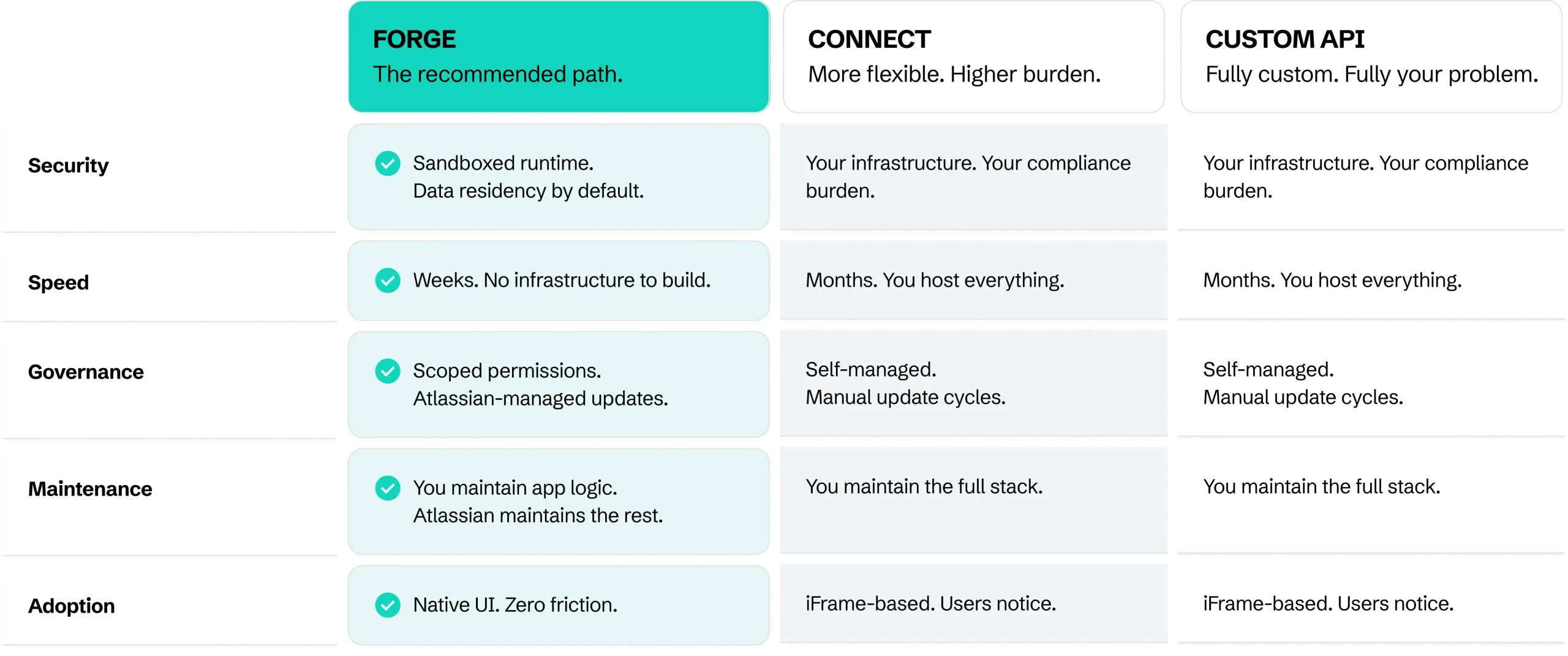
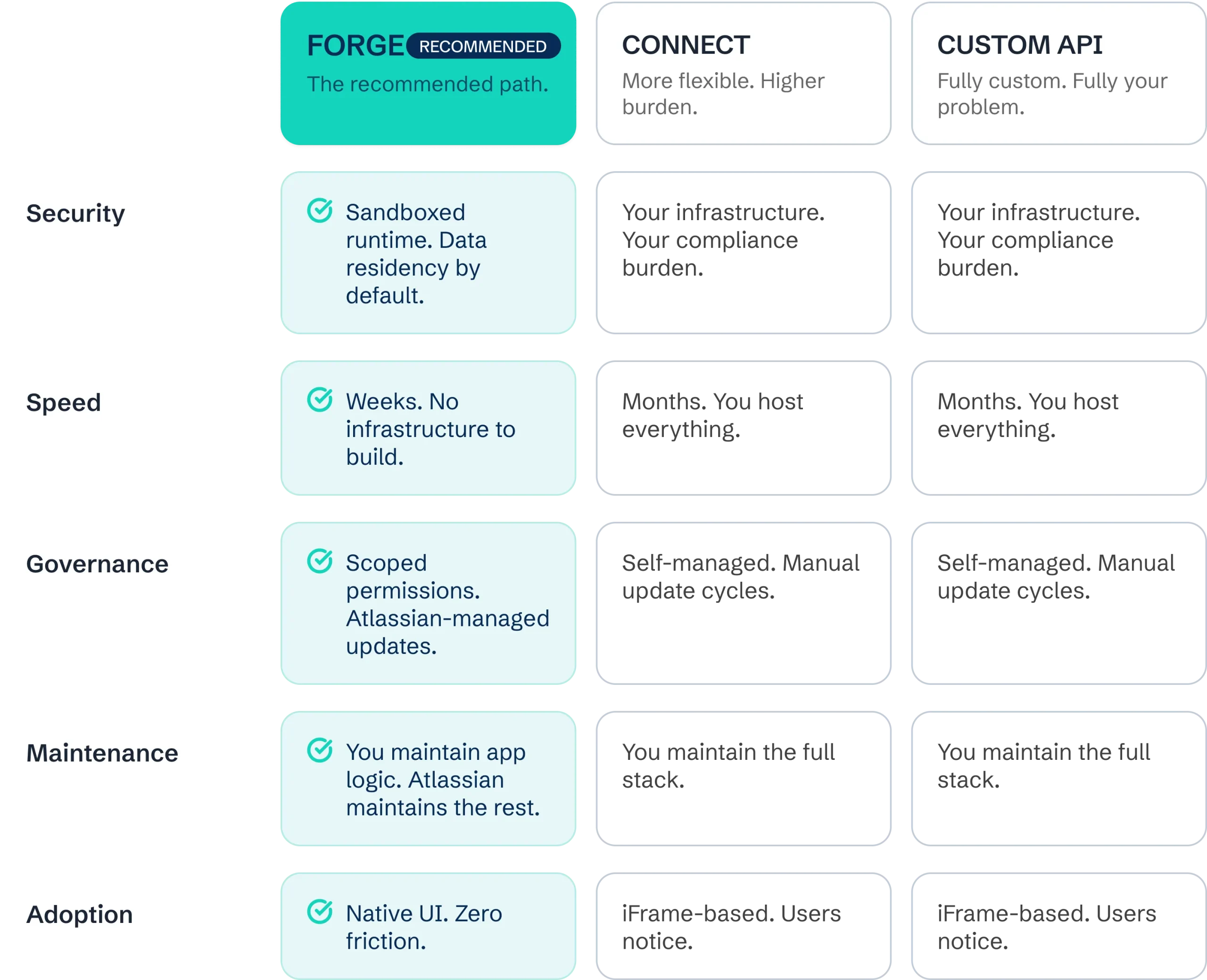
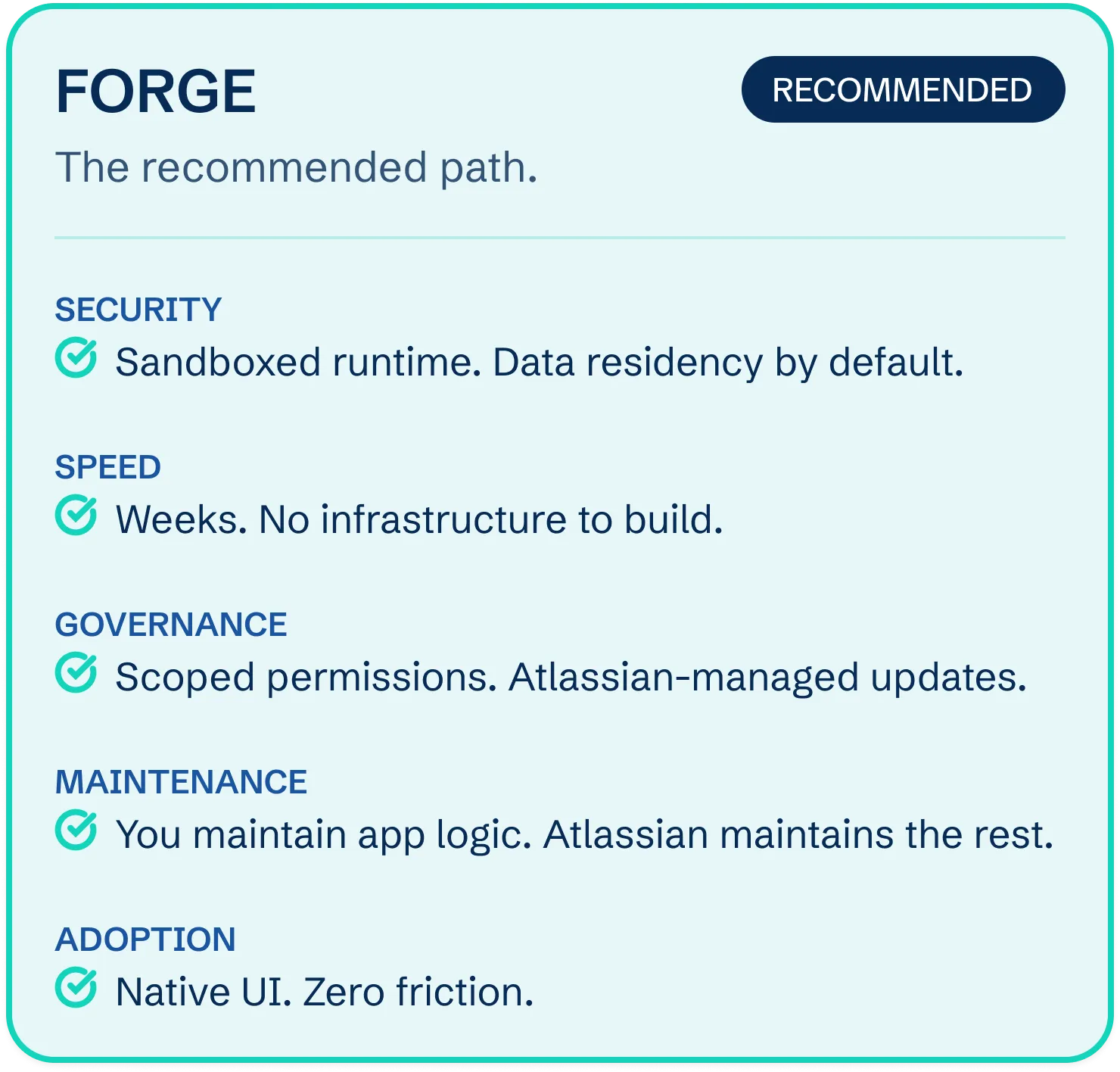
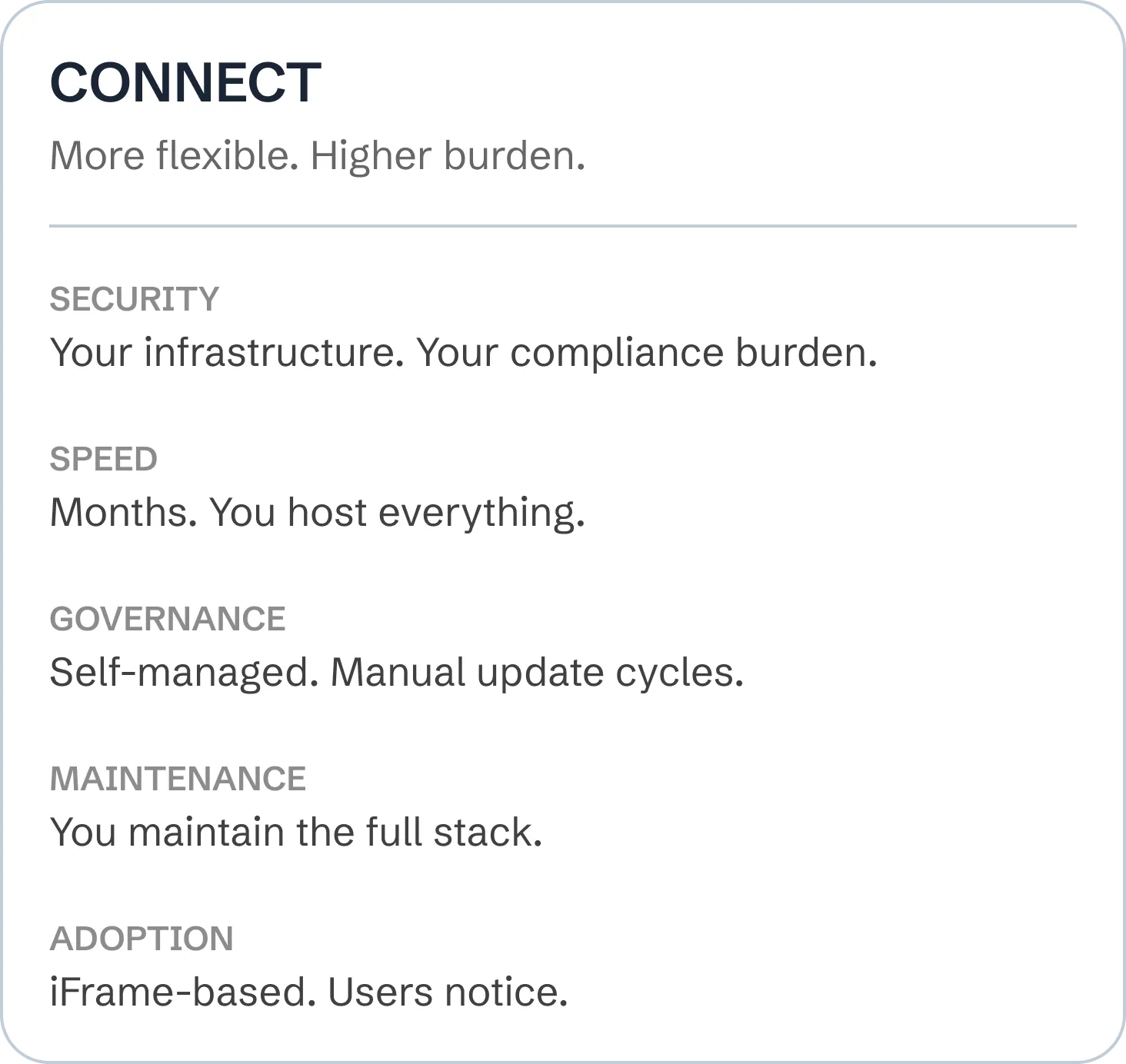
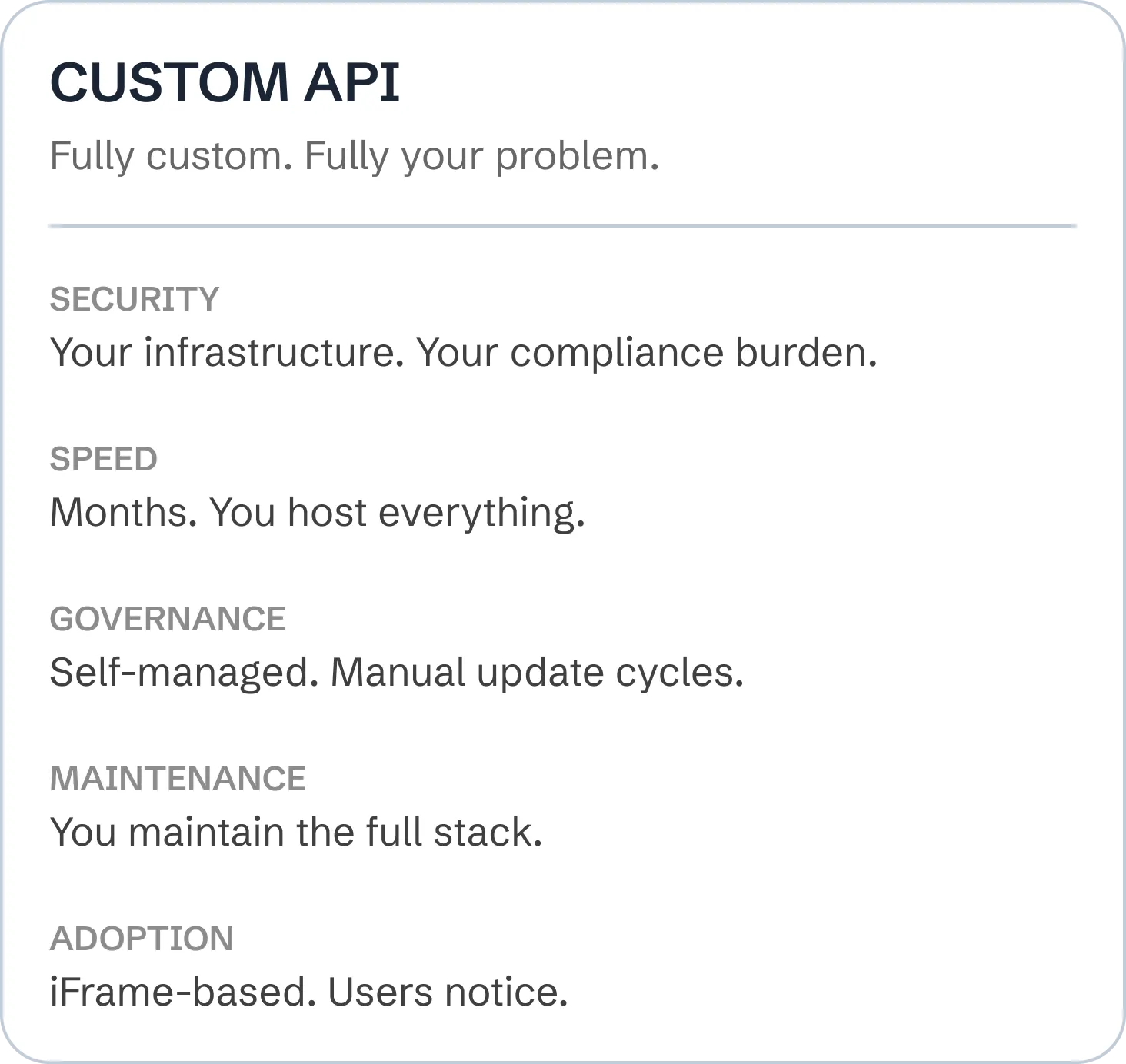
Heads-up on cost of ownership.

Three ways to extend Atlassian. Five dimensions that decide the bill in year two.
Forge is not always the answer. But when it is, the gap between Forge and the alternatives is not close.

Scope and price you see before you sign.

Every engagement is fixed scope and defined timeline. You see what you’re committing to before you sign.
1 – 2 weeks
Know what to build, what to buy, what to retire.
Stakeholder interviews. Workflow gaps mapped. ROI sized. You get an executive-ready brief with a build, buy, or retire recommendation your team acts on Monday.
1 – 2 weeks
Prove it works before you fund the production build.
Working prototype in your sandbox. Tested against your success metrics. Ends with a demo day and a clear go or no-go decision.
1 – 2 weeks
Hardened. Tested. Documented. Live.
Production-ready app deployed with a rollout plan that has names and dates on it. SLAs and observability go live the same day the app does.
1 – 2 weeks
Better every quarter. No new headcount.
Managed releases. Dependency updates. Incident response. Your apps compound value across the year instead of decaying between funding cycles.

A smarter decision starts with one call.

One business day to respond. Thirty-minute scoping call. No pitch. We come out of the call with a Forge Value Assessment scope or with a clear note that Forge is not your right move.

Latest from Trundl.

The ACD position paper

Our point of view on Accelerated Contextual Delivery, the model behind delivery in days.The definitive guide to Accelerated Contextual Delivery.

The Toshiba story

How Toshiba’s hardware teams were testing their own Jira by the second meeting.

From the blog

Our latest thinking on enterprise delivery and AI.

Common questions.

What is Atlassian Forge?
Forge is Atlassian’s cloud-native app development platform. Apps built on Forge run inside Atlassian’s own infrastructure, which means data stays within Atlassian’s trust boundary, permissions are scoped automatically, and there is no separate hosting to manage. For enterprise teams, it is the most governed path to extending Jira, JSM, and Confluence with custom functionality.
Connect apps run on your infrastructure and render inside Atlassian products via iFrames. Forge apps run directly within Atlassian’s sandboxed runtime. In practice, Forge gives you data residency by default, Atlassian-managed security updates, and a native UI that users cannot distinguish from core product features. Connect offers more architectural flexibility but shifts the entire compliance and hosting burden to your team.
A typical assessment takes one to two weeks. A proof of concept runs two to four weeks. A production build ranges from four to eight weeks depending on complexity. Rapid Deploy methodology uses fixed scopes and defined timelines, so both sides know exactly what the engagement looks like before it starts.
Forge runs inside Atlassian’s FedRAMP-authorized, SOC 2-certified cloud infrastructure. Data residency controls are available by default. Your app inherits Atlassian’s compliance posture rather than needing to build its own. A compliance review is included in every Forge Assessment to map the platform against your specific regulatory requirements.
A use-case shortlist of five to ten opportunities, reference architectures for priority items, compliance notes, T-shirt cost estimates, and a prioritized roadmap. The output is an executive-ready brief with a build, buy, or retire recommendation for each use case. The goal is a clear decision framework, not a pitch for more work.
In many cases, yes. The assessment evaluates your current Connect apps and flags which ones are strong candidates for migration based on complexity, maintenance cost, and compliance requirements. Not every Connect app needs to move, but the ones that do typically see reduced maintenance overhead and a stronger security posture.
Forge has platform constraints, particularly around long-running processes and certain UI customizations. Those limits surface during the assessment, not after the build starts. When Forge is not the right fit, the recommendation covers alternatives including Connect, marketplace apps, or custom integrations. The assessment exists so your investment goes to the right path, even if that path is not Forge.