The Contextual Delivery engine
PROOF
Outcome-priced engagements, with a guaranteed delivery window.
See the ResultsHOW IT CONNECTS
Start at any industry, reach any solution, and back. Industry knowledge plus Rapid Deploy.
FEATURED
The engine behind every Atlassian service. Days, not months.
Book an Assessment
Built different from
day one
We are Hiring!
Copilot enablement and managed services that meet your enterprise standards.
Join the TeamHow Trundl thinks and ships
STORY
How Toshiba's hardware teams were testing their own Jira by the second meeting.
Read the story
BLOG
Our point of view on Accelerated Contextual Delivery, the model behind delivery in days.
Read the latest
PROOF
Outcome-priced engagements, with a guaranteed delivery window.
See the ResultsHOW IT CONNECTS
Start at any industry, reach any solution, and back. Industry knowledge plus Rapid Deploy.
Trundl rebuilds how engineering and program management teams work, with AI woven into delivery. Working systems in days, existing programs never interrupted.
Days, not Months
Connect across your systems
Experiment, test, and refine, quickly
From product strategy to production ramps, teams must deploy AI assistants that’s are auditable and owner-bound. Trundl marries smart AI strategies to smart manufacturing practices.
The service operation IT already runs, extended to the events that threaten program continuity: supply disruptions, workforce redeployments, access changes.
Programs keep running through the re-tooling. Hardware and software teams land in workflows rebuilt for how they actually work, phases and gates included.
Relying on an integration that only one engineer understands is not good. Re-build critical integrations or features as secure, Atlassian-native apps.
Documented patterns across the solutions.
A supply disruption becomes governed workforce redeployment: eligibility checked against certifications and equipment, five functions in parallel.
Requirement-to-test links configured in Jira at the point of work. The next assessment pulls from Atlassian directly.
Toshiba moved eight teams in a day, program tracking included.

Engineering, quality, and program workflows in Jira, JSM, and Confluence, plus the connections to your PLM and ERP platforms.

Plant-floor systems, MES, OT networks, and the physical product itself.
A 60-page export in. A working Jira instance out, the next day.
users
Teams
to working instance
saved per year
not weeks build
One workshop mapped eight teams of workflows, including the earned value tracking that had kept them on Smartsheet.
Rapid Deploy returned a working Jira instance the next day, workflows rebuilt for the platform.
Each team validated their workflows by role. Changes shipped same day.
Teams cut over. Smartsheet seats retired. $60K a year back.
Trundl’s job isn’t to follow a platform roadmap. It’s to arrive ahead of it, operationalize what’s possible, and deliver outcomes where it counts: on the ground, in the workflows that run the business.
CTO, Trundl
HIPAA-aligned governance from the first configuration. Clinical workflow design. Medical-device safety as a flagship use case.
AI², CSX², Migration², and AppDev²: composable patterns, tuned to program constraints.
Walk us through your estate and the three workflows your programs spend the most coordination time on. Trundl returns the assessment, the plan, and the timeline.
Remote, on-site, or hybrid
12 hours, one or two days
Trundl architects + your platform owner, program management lead, and one workflow owner
Current-state assessment, scoped plan, timeline
Bring your stakeholders. Bring your requirements.
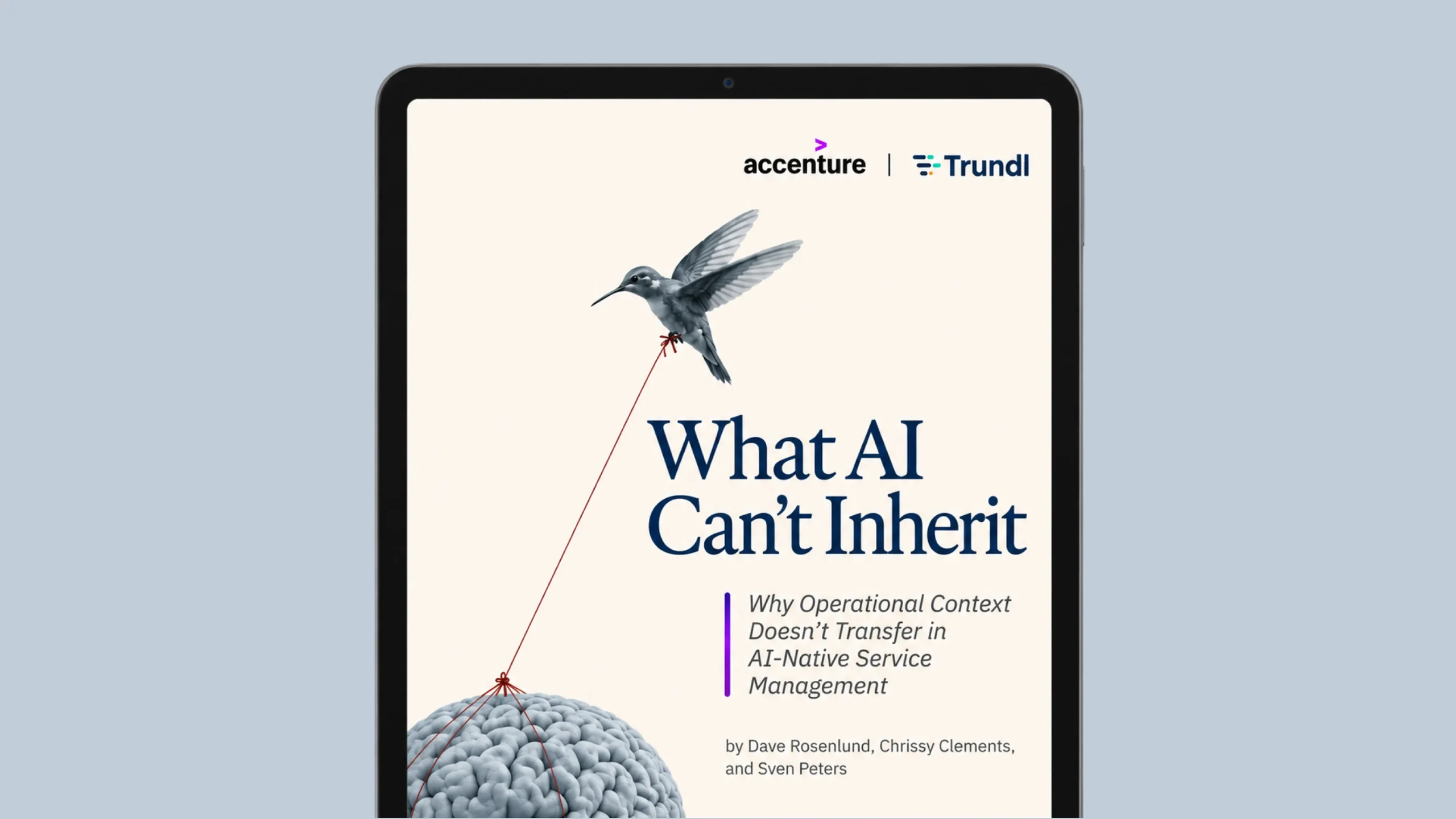
The Accelerated Contextual Delivery whitepaper.
Eight pages. Built for CIOs, CTOs, and VPs of platform strategy.
Toshiba
Eight teams, one day. 100 users off Smartsheet in a day, workflows rebuilt for the platform.
AppDev²
for the integrations carrying program weight. PLM, ERP, and MES data flows rebuilt governed.
CSX² (Customer Service eXperience squared) is Trundl’s composable solution that unifies IT service management, Enterprise Service Management, and Customer Service Management into a single system. The system is built on the Atlassian Service Collection. CSX is the outcome. CSX² is the system that produces it.
No. Trundl does not touch plant-floor systems, MES, OT networks, or the physical product. Our buyer is the engineering organization: the teams running NPI programs, gate reviews, and hardware and software co-development.
Yes. How Jira and Confluence are configured directly affects ASPICE performance. Trundl configures requirement-to-test traceability at the workflow level, time-stamped and attributed, so a Level 2 or Level 3 assessment pulls evidence from the system of record instead of reconstructed spreadsheets.
Traceability from safety goals through requirements, design, implementation, and testing is configured in the workflow, with sign-offs that create an auditable record, and change control tied to IATF 16949 where the automotive supply chain requires it. Evidence capture happens at the point of work.
Yes, and we treat it as the primary design constraint. Migrations run phased and in parallel, hardware teams land in an environment mapped to their phases and gates, and nothing cuts over mid-milestone without the program manager’s sign-off.
Yes. Gate review packages need consolidated status from every discipline, and manual reconstruction is where programs lose days. Trundl configures Jira and Confluence so program status assembles from live work, with earned value tracking where programs need it.
Yes. Windchill, Teamcenter, SAP, and Oracle integrations are common AppDev² builds, rebuilt governed so they stop depending on one engineer and self-managed infrastructure. On Forge where the platform allows, on the runtime that fits when it cannot.
Trundl does not integrate into MES systems directly, but the data flow from MES into Jira, so field issues and manufacturing defects become engineering work, is a common AppDev² conversation.
AI drafting safety documentation or summarizing program status gets full attribution in Jira and Confluence, human review at every regulated step, and boundaries per workflow. When an ASPICE or ISO 26262 review asks what AI contributed, the answer comes from the system of record.
Access boundaries, data residency, and audit trails are configured as design inputs, and components carrying ITAR or export-control flags get governed workflows with evidence capture built in. Trundl holds ISO 27001 and SOC 2 Type II certifications.
Yes, and the tooling reflects it. Hardware teams run phases and gates, EVT through PVT, while software teams iterate. Trundl configures the platform to carry both cadences without forcing sprint language on mechanical engineers.
The platform owner, the program management lead, and one workflow owner. The program manager is usually the most important voice: cross-team visibility, gate reviews, and program status without manual reconstruction are their daily problems.
The first working configuration lands in 7 to 18 business days through Rapid Deploy. Migrations compress 50 to 75%. Custom Forge apps run one to two weeks of assessment, two to four of accelerator, four to eight of production build.

Trundl configures those platforms too: Sync connectors cover monday.com migrations, and Microsoft work is delivered by certified specialists as an expert-led service. In regulated engineering environments, engagements are predominantly Atlassian-first.