



Atlassian just announced a wave of agentic development capabilities in Jira, and the most important sentence in the whole launch isn’t about AI at all.
The hard parts of shipping software are still hard.
And all the AI we’re seeing now in the software development lifecycle (SDLC) has not changed that.
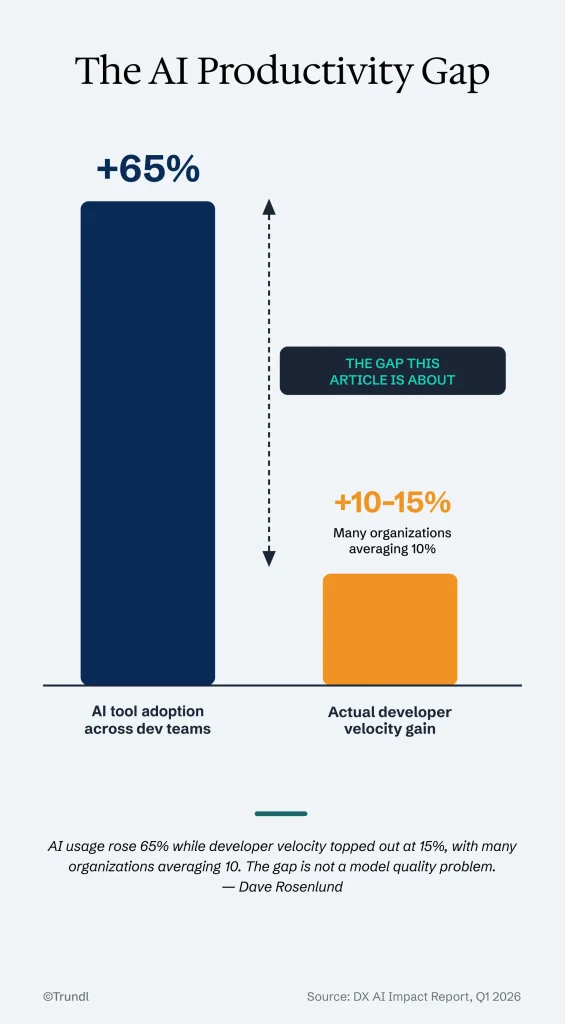
Coding agents write more code every month. Atlassian says as much itself. In a longitudinal study it ran with DX, the company reports AI usage rose 65% while developer velocity did not, topping out around a 15% gain, with many organizations averaging 10.
This AI developer productivity ceiling, usage climbing while velocity flatlines, is consistent across multiple independent studies.
That gap is the story. It is not a story about model quality.
The prevailing assumption in most enterprises is that a better AI model closes the gap. Faster autocomplete, smarter agents, a bigger context window, and the productivity curve finally bends. Atlassian, like most vendors, has spent the AI boom selling what better models can do, which is what makes this launch notable: it concedes, in public, that the assumption is wrong.
But writing code was never the hard part of this work. The hard part is judgment. Which problem is worth solving, how the system you’re touching will push back, and what “finished” means inside an organization with real constraints and real history. A model that types faster leaves all of that untouched.
The bottleneck was never the code.
Atlassian named the right problem
Give the launch credit for its framing, because the framing is correct.
The goal, in Atlassian’s words, is to make the SDLC “legible to agents without becoming less accountable to humans.” That’s a better sentence than most vendors manage, and it holds up.
Atlassian breaks it into three requirements, none of them features.
First, the intent has to exist before the agent starts. Not a one-line ticket, but the real requirement, the part of the architecture in play, the decisions already made, and the constraints everyone assumes and no one has written down.
Second, and this is the launch’s sharpest line, the workflow should not, in Atlassian’s words, “fork every time the runtime changes.” Cursor on the web tier, Claude Code on a hard backend service, a cheap built-in agent for the routine fixes: switching between them shouldn’t force you to rebuild the flow of work each time.
Third, the autonomy has to stay in view. The moment an agent’s work lives only in a terminal, a browser tab, or a log no one checks, you’ve handed off the work and kept none of the accountability.
Get those three right and the agent stops acting like a copilot bolted onto the side. It becomes another participant in the same flow of work as the humans.
It took much of the industry two years to say that out loud. Atlassian said it.
The real announcement is a control-plane bet
Strip the feature list away and look at the shape of the thing.
Atlassian isn’t trying to build a better coding agent. It’s trying to own the layer above all of them. Think Kubernetes, not VS Code. The win isn’t another agent. It’s coordinating all of them. Assign work to Claude, Cursor, or Copilot, with Codex coming. Watch the session whether it runs in the cloud or on a laptop. Route routine fixes through automation rules. Measure spend and cost per pull request across every tool. The agent is interchangeable. The system of record is not.
That’s the bet. Whoever writes the code, Jira wants to hold the workflow around it: where the work is defined, who it goes to, what the agent did, and whether the result earns a merge. Teamwork Graph is the differentiator, because context is the thing that’s genuinely hard to replicate.
It’s a coherent bet, and for teams already all-in on Atlassian, it’s a reasonable one.
It also rests on an assumption nobody in the launch wants to examine.
The graph only knows what you have told it
The whole promise rests on one line from the announcement: “the Teamwork Graph supplies the context.”
The graph is supposed to map how your work actually connects: the tickets and the code, the people and the decisions behind them, and what depends on what. When it’s rich, an agent can anchor on the right service, follow the real relationships, and come back with something a senior engineer trusts. That’s the promise, and when the substrate is healthy, the promise is real.
Now look at your actual Jira.
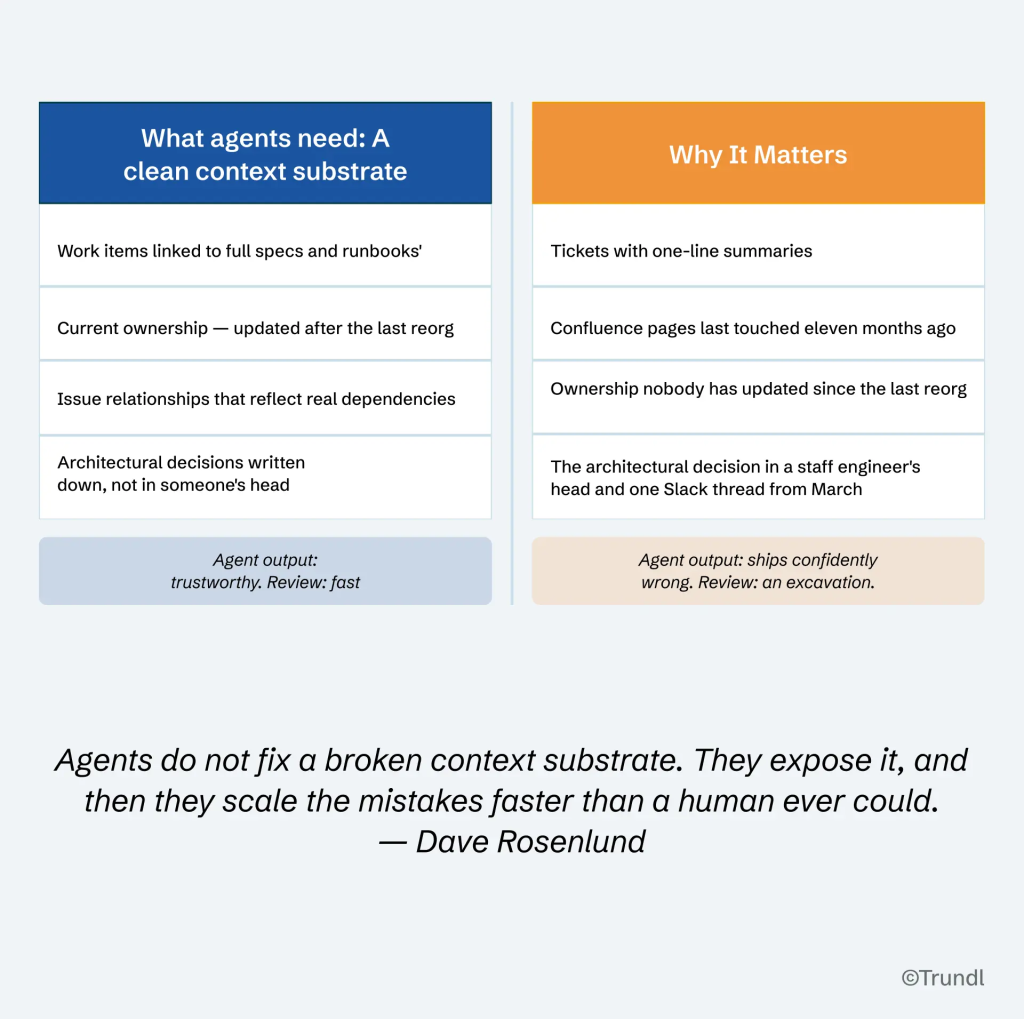
Most enterprises don’t run on a clean graph. They run on tickets with one-line summaries, Confluence pages last touched eleven months ago, ownership nobody has updated since the last reorg, and the architectural decision that lives only in a staff engineer’s head and one Slack thread from March. The organizational memory the launch assumes you already rely on is, for most teams, a fiction held together by the three people who remember how things really work.
This is organizational knowledge debt: undocumented tribal knowledge that agents surface and scale before anyone realises how much weight it was carrying.
In 1985, Peter Naur argued that programming is theory building. The real artifact isn’t the code. It’s the shared mental model of how the system works and why. An agent holds no standing theory of your codebase. It rebuilds one from whatever context you hand it, every session, which is why the state of that context decides everything.
Hand that same agent a thin graph and it doesn’t stall. It ships. It writes clean, tested code against an assumption nobody put in the ticket. It rebuilds a utility the team tore out two quarters ago for good reason. It wires a new feature into a service that’s quietly being decommissioned, because nothing in the graph said the service was on its way out. Everything compiles. Everything passes. And the review turns into an excavation of decisions no one wrote down.
Agents do not fix a broken context substrate. They expose it, and then they scale the mistakes faster than a human ever could.
The boring work just became the advantage
This is the part practitioners will recognize, because they live it.
The teams that win with agentic development aren’t the ones who adopt the most agents. They’re the ones who already did the unglamorous work: linking work items to the specs and runbooks that explain them, keeping ownership current, using issue relationships that mean something, writing down the decision instead of making it in a meeting and moving on.
That discipline, what AI practitioners are increasingly calling context engineering, is what makes an agent’s output trustworthy.
That work was always valuable. It was just easy to defer, because humans are good at filling the gaps with tribal knowledge, and the cost of a messy graph stayed hidden.
Agents remove the hiding place. They can’t ask the person three desks over what “migration” means this quarter. They take the graph literally, which makes the quality of your context the ceiling on the quality of your output.
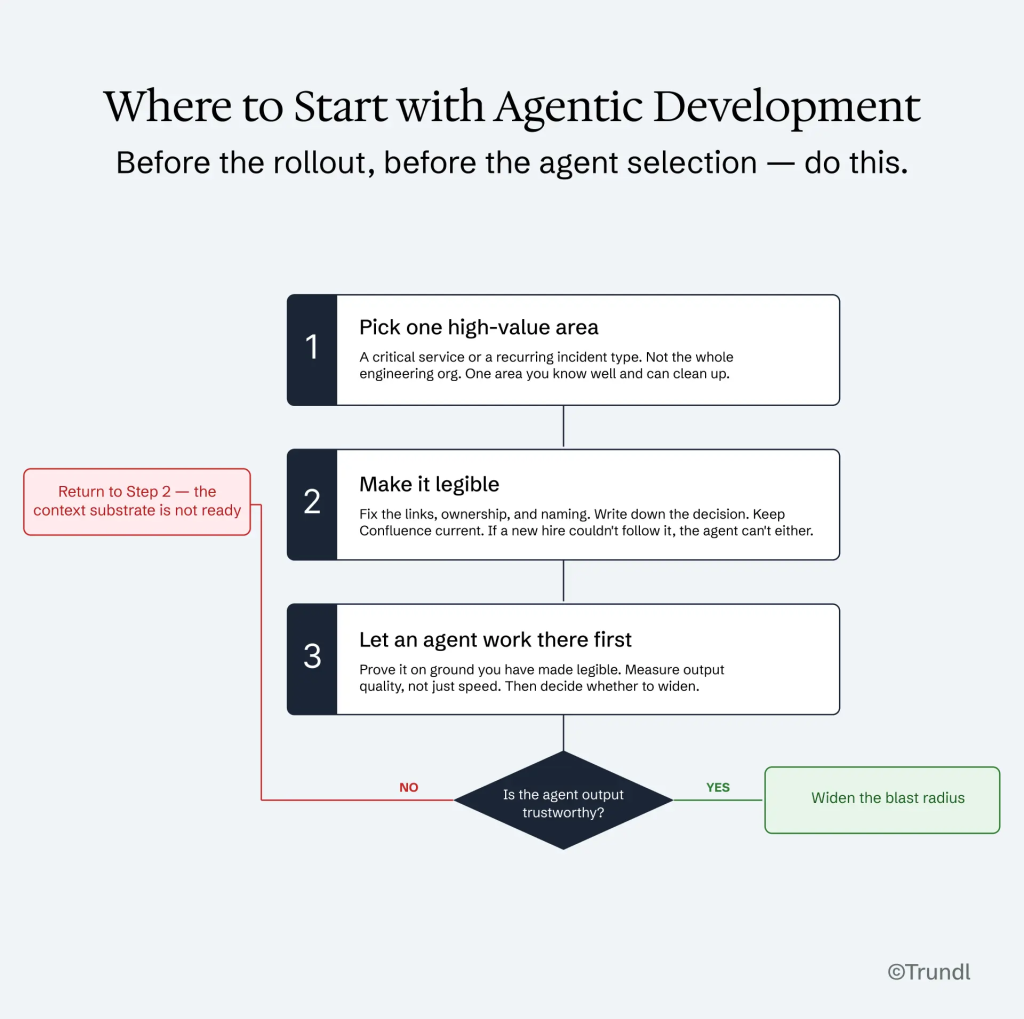
So the move is not a rollout. The move is to pick one high-value area, a critical service or a recurring incident type, clean up its links, ownership, and naming, and let an agent work there first. Prove it on ground you have made legible before you widen the blast radius.
This launch did not retire the boring work. It raised the price of skipping it.
Take the direction seriously. Take the numbers with a grain of salt.
Atlassian says that internally, agents enriched by the Teamwork Graph produced 44% more accurate results while using 48% fewer tokens than agents without it, along with shorter PR cycle times and less time spent on routine work.
Impressive, and almost useless to you as a forecast.
These are vendor-reported numbers with no baseline, no methodology, and a sample that is about as unrepresentative as it gets. Atlassian’s engineering org runs on the cleanest Teamwork Graph on earth, built by the people who build the graph. Your mileage will not merely vary. It will depend entirely on the state of your own substrate.
None of this means the direction is wrong. The direction is right. The numbers are marketing.
Agents want the documentation agile taught us to skip
Spec-driven development sits at the center of this launch, and it is a decade of “working software over comprehensive documentation” running in reverse. Agents need the specification we spent years learning to skip.
That isn’t a contradiction to wave away. It’s a real tension teams will have to work out, because the upfront rigor agile taught us to distrust is exactly what an agent needs to do good work.
The part the launch leaves to you
None of this slows the shift. Agents are going to reshape how software gets made, and fast.
What they won’t do is think for you, conjure the context they’re missing, or answer for the result when something ships broken. Skip any of that and the cost climbs, because an agent working from a bad map produces bad work quickly, and with more confidence than any person would.
The vision of humans and agents building side by side is a good one. It’s also a wager on a foundation most organizations haven’t laid yet.
So the question this launch really leaves you with isn’t which agent to hire. It’s whether your own context is in good enough shape to be worth handing to one.
Build the map first.
Originally published on the Atlassian Community