Test your Atlassian Cloud before you cut over.

Trundl rapidly builds and modernizes your Data Center configuration
into a working, test-ready Cloud environment. Test within days, validate
within a week, and cutover before the end of the month.

Trusted by teams building on Atlassian.

Atlassian Data Center to Cloud. Guaranteed before renewal.

Your DC license is up for renewal.

Your DC license is up for renewal.

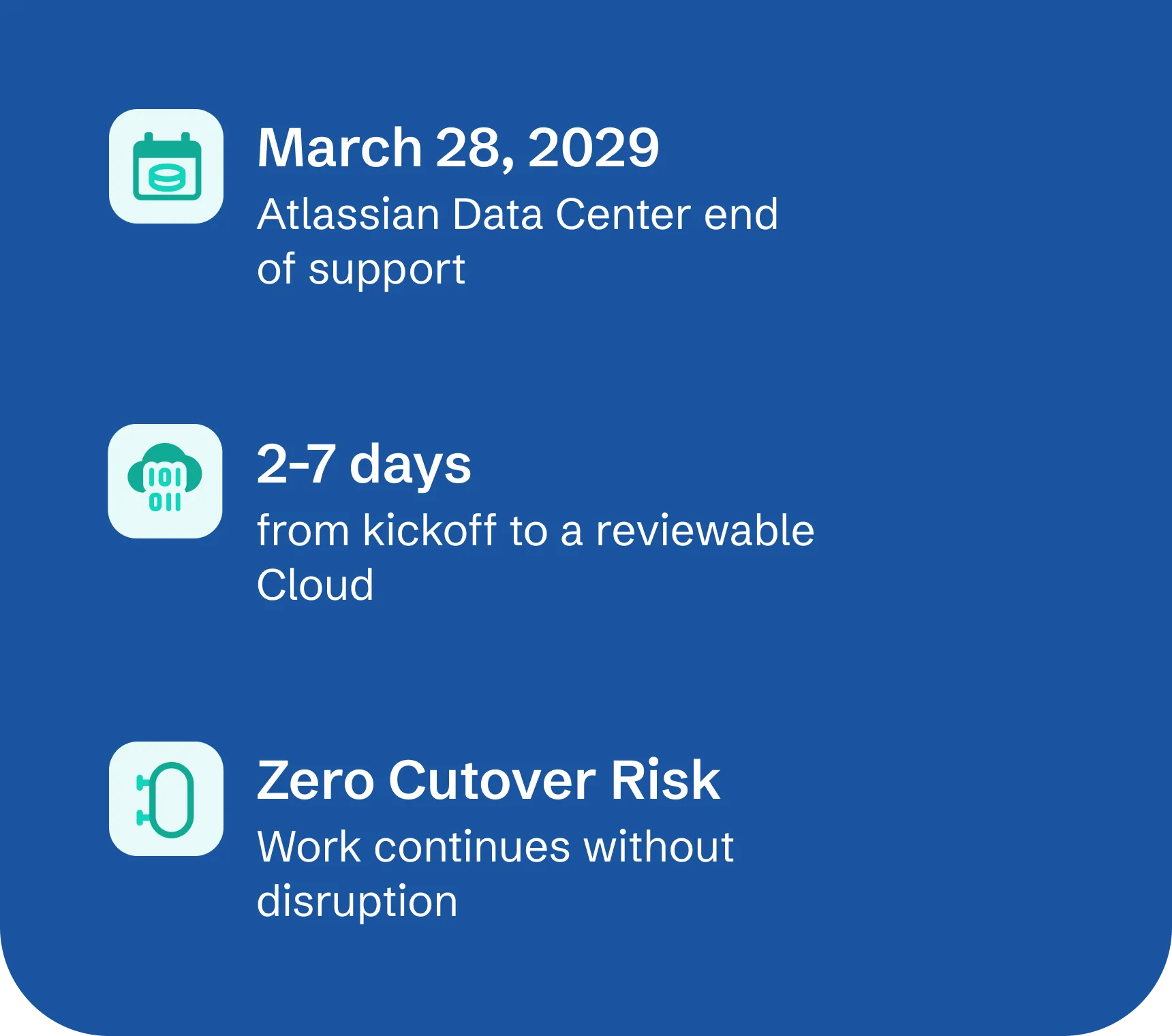
The renewal date is fixed. Before you sign a Cloud quote, Trundl shows you a Cloud build that runs on your DC config.

Your apps and customizations are unclear in Cloud.

Your apps and customizations are unclear in Cloud.

Marketplace apps, Forge customizations, and the custom logic your team built over the years land differently in Cloud. Trundl identifies what ports, what rebuilds, what retires.

A prior migration attempt burned the last quarter.

A prior migration attempt burned the last quarter.

Past test migrations and delta tools left questions open. A working Cloud build that your team runs and signs off closes them, before any cutover commitment.

Validate the Cloud before you commit.

A test-ready cloud environment in days.
You validate, then commit. The cutover is mechanical.

Analyze

Discovery reads your live Data Center instance. Configurations, custom fields, workflows, schemes, apps, and integrations get mapped automatically with no documentation required.

Build

A reviewable Cloud environment stands up from the Discovery output. Workflows get ported, apps get configured or flagged, and custom logic gets recreated.

Validate

Your team works in the Cloud build, tests the actual workflows, apps, and data, and signs off issues before any cutover commitment.

Cutover

Cutover is mechanical. Your team has already signed off the Cloud environment. Cutover day moves the data on a schedule you set.

Analyze

Discovery reads your live Data Center instance. Configurations, custom fields, workflows, schemes, apps, and integrations get mapped automatically with no documentation required.

Build

A reviewable Cloud environment stands up from the Discovery output. Workflows get ported, apps get configured or flagged, and custom logic gets recreated.

Validate

Your team works in the Cloud build, tests the actual workflows, apps, and data, and signs off issues before any cutover commitment.

Cutover

Cutover is mechanical. Your team has already signed off the Cloud environment. Cutover day moves the data on a schedule you set.

Your Data Center config becomes the Cloud build.

The DC config Discovery reads

Discovery reads your live Data Center instance directly. Configurations, custom fields, workflows, schemes, apps, and integrations get mapped automatically. No written documentation required.

The Cloud Deployment builds

Deployment generates a working Cloud environment from the Discovery output. Workflows get ported, schemes get recreated, and apps get configured or flagged for replacement and retirement.

The sync that keeps teams working

Sync runs bi-directionally between DC and Cloud during the validation and cutover window. Teams keep working in DC while Cloud gets tested. Cutover is the only single-cut event.

DentalXChange retired a decade of Data Center with zero disruption.

Trundl mapped every Jira and Confluence instance across the acquisition portfolio. Cross-portfolio reporting landed in the first week. Two acquisitions consolidated onto the parent instance in the first quarter.

10 years

instances mapped

Zero

disruption to teams

Days

to a reviewable Cloud

100%

apps mapped

1 day

cutover window

DC instance mapped

Trundl read the live DC instance. A decade of accumulated config, custom fields, workflows, and apps got mapped automatically.

Cloud build stood up

A reviewable Cloud environment stood up from the Discovery output. Workflows got ported, apps got configured or flagged.

Workflows tested in build

DentalXChange teams ran their actual workflows in the Cloud build. Issues surfaced and fixed before any cutover commitment.

Confident Cutover

A controlled cutover. Bi-directional sync kept teams working through the transition. The DC instance retired the day after.

When the engagement was considered closed there was really nothing left for us to have to worry about. Everybody just used it and loved it.

Scott Checkoway,

CIO, DentalXChange

No surprises. How migrations should be.

Apps without a Cloud version, flagged in discovery.

Marketplace apps without a Cloud equivalent surface during discovery, not after cutover. Each one is flagged to replace, rebuild, or retire. Custom workflows and Forge apps get the same treatment

Custom workflows ported with their logic intact.

Workflows, schemes, and automation rules move from Data Center to Cloud through the discovery output. Logic gets recreated where Cloud needs a different shape. Your admins sign off.

Identity and SSO validated before cutover.

Atlassian Access connects identity and SSO through to the Cloud build. The configuration gets validated in the working environment. Your IAM team confirms before any user hits the new tenant.

Read access in. A validated Cloud tenant out.

What you bring

Read access to your Data Center instance, your platform admin, and one stakeholder for app and workflow decisions. No documentation required. Transformation is on the table, too. Be ready to talk!

How it works

Go from discovery, to design, to testing, in days. You validate. Trundl refines, and the cutover countdown begins when you are ready.

What you ship

A working Cloud tenant migrated from your DC instance. Workflows ported, apps configured or flagged, identity validated. Post-cutover support and partner handoff included.

Transform while you migrate, in one motion.

Show us your instance. Tell us your cutover goals. Let Trundl’s Rapid Deploy engine do the hard work.

Common questions.

Why should we see our Cloud environment before committing to migrate, instead of just planning the cutover directly?
Because a Cloud plan built on assumptions is a different thing from a Cloud environment your team actually needs. Trundl builds a reviewable Cloud environment from your real Data Center configuration and any additional transformation-specific context first. Your team validates real workflows, apps, and data before anyone signs off on a cutover date. This unique process, enabled by Contextual Delivery, is what removes the guesswork from traditional Data Center to Cloud migration engagements.
Engagements typically run weeks, not months, from discovery to cutover, with the specific timeline fixed during the scoping phase before build begins. The reviewable Cloud solution itself is often ready for your team to start testing within days of Discovery completing.
Trundl’s discovery phase reads your Data Center configuration directly, not from documentation that may be out of date. Workflows, schemes, custom fields, and permission structures get inventoried from the live instance and carried into the build, so the target Cloud environment reflects how the instance actually runs today, not an assumption about how it should run.
Every app gets mapped during discovery and gets a decision before cutover. We like to avoid surprises on cutover days. Apps with a Cloud equivalent get configured directly. Apps without a Cloud version get flagged early, with the options laid out plainly: replace it with a Cloud-native equivalent, rebuild the functionality another way, or retire it if it’s no longer earning its place.
Identity and SSO connect through Atlassian Access, and that connection gets validated inside the built Cloud environment before cutover, not assumed to work once the team lands there. Access should work correctly from the first login on the new environment.
Yes. Seeing a reviewable Cloud build does not force an early commitment. We do, however, recommend getting to Cloud sooner than later. Cloud features enable more visibility and more velocity with teamwork. We want to get you working where the future is going. Q7: What about our compliance and audit posture through the migration?

Trundl is ISO 27001:2022 certified, SOC 2 Type II compliant, and GDPR aligned, and DC to Cloud migrations run on the same parallel-run validation discipline used across every Trundl migration: source stays live, target gets validated against real workflows and data, and cutover only proceeds once that validation passes. Audit trails and access boundaries move with the workflows rather than getting rebuilt from scratch on Cloud.