




When Self-Service Meets the Enterprise.
monday.com’s AI is making anyone a builder. That changes what durability requires.

Patrick Howell
Co-CEO and Co-Founder, Trundl





About Trundl
Trundl is an enterprise delivery technology company, founded in January 2014 and headquartered in San Jose, California, operating across the United States, Canada and India. It has delivered for more than 450 enterprises and reports a 95% license renewal rate.
Trundl is an Atlassian Platinum Solution Partner and a monday.com Silver Partner. It is ISO 27001:2022-certified, SOC 2 Type II-attested, and GDPR-aligned.

About the Author
Patrick Howell is Co-CEO and Co-Founder of Trundl, Inc. He leads go-to-market strategy and operations for Trundl, which includes multiple regions and platform verticals. Along with his fellow co-founders Jitesh and Manohar, Patrick has led Trundl from its beginnings as a boutique four-person IT consultancy to an enterprise work transformation company with 130+ employees. Previous to Trundl, Patrick spent a decade in marketing, primarily at Dell Technologies. Patrick lives in Cleveland, Ohio.
Executive Summary
The buying question for monday.com has changed. Since May 2026, its AI lets authorized users build and run a workflow without engineering support. The old question, can we design, deploy, and manage this ourselves, at first pass points towards: yes. The harder question is whether it stays correct as the organization changes.
That depends on three kinds of knowledge no builder holds alone.
Business knowledge
the stages and approvals
Governance knowledge
who may change it and what an agent may decide
Integration knowledge
whether it still matches the systems it copied from
None of it survives once a second team inherits it.
That knowledge has to be applied at deployment, where a workflow meets the organization’s people, policies, and systems. Treating deployment as a first-class engineering problem is what turns monday.com from a fast configuration tool into a platform other teams standardize on. Someone has to own that work before the second team inherits the workflow.
None of this is an argument against self-service. The faster monday.com makes it to build a workflow, the more workflows exist that someone has to keep correct. Trundl, an implementation partner for monday.com and Atlassian, calls its approach to that work Contextual Delivery. It starts from the organization’s records, builds governance in as it configures, and keeps monday.com aligned with its systems.
01
The Pilot Works Because One Person Holds the Context
An Operations lead builds an intake workflow in an afternoon. Nine months later, a review asks who owns it.
An Operations lead describes the intake process in plain language and ships the pilot before the end of the day. monday.com’s pricing page promises a custom business app “in minutes,” and the promise holds. Three monday.com terms are enough to follow what happens next. A board is the table where a team tracks its work: one row per request, with columns for status, owner and dates. An automation is a rule attached to a board, such as “when status changes to Approved, notify Finance.” An agent is an AI worker that reads the board and acts on it.
The Operations lead asks Sidekick, monday.com’s AI assistant, to build the intake board and its automations. With the right permissions and AI access enabled, any user can do that. She turns the request form into a small app using vibe, monday.com’s app builder, and the app stays hers until she publishes it to the wider workspace.

She also wants each request routed according to what it asks for, and that needs an agent. Only an administrator can create one. She asks the platform administrator, who sets the agent up from her description the same afternoon, and the agent starts working with the instructions she gave.
Month one looks like success. The workflow works because she alone knows what it is meant to do. Every approval rule, every exception for the region that skips a step, and every definition of “done” lives in her head. The build did not write any of that down, because it did not need to.
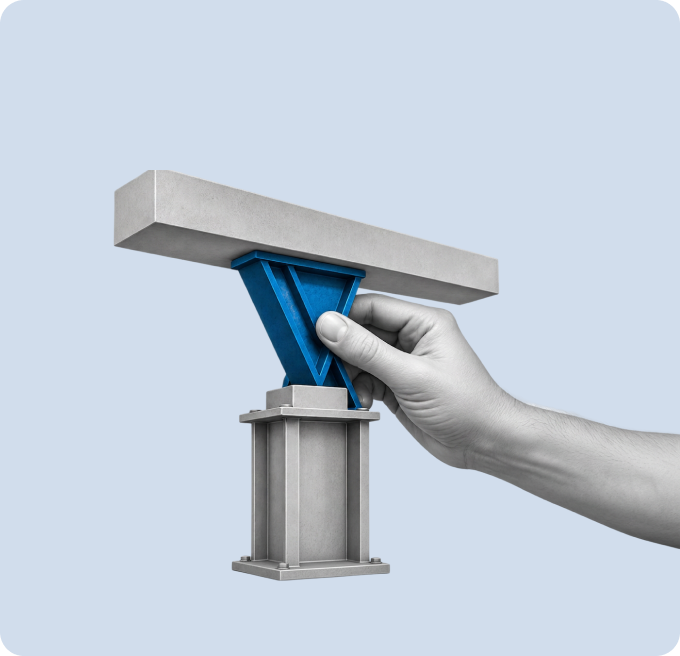
Month nine looks different. A second team has copied the board and changed its stages. The administrator who set up the agent has moved roles. A governance review asks who owns the workflow, who approved what the agent is allowed to decide, and where the record of changes is. The agent’s own run log shows what it did and when. It does not show why it was set up that way, or who decided that instruction was the right one. Nobody in the room can answer that part.
Every pilot approved on a demo alone has this shape. The question worth asking is which pilots in your organization a second team is about to inherit.
02
Self-Service Solved Construction, Not Durability
monday.com’s AI layer removes the build friction that used to require an admin or a consultant. It moves the bottleneck rather than removing it: from construction to what comes after, ownership, consistency across teams, and agreement with the rest of the organization’s systems.
Self-service removes the effort of the build. It does not decide whether the workflow is still trustworthy six months and three teams later. That depends on context no single workflow holds.
The expensive part of every platform rollout has always been the years after go-live, when the organization changes and the configuration does not. So the decision in front of a buyer is what is being bought: speed of construction, or durability.
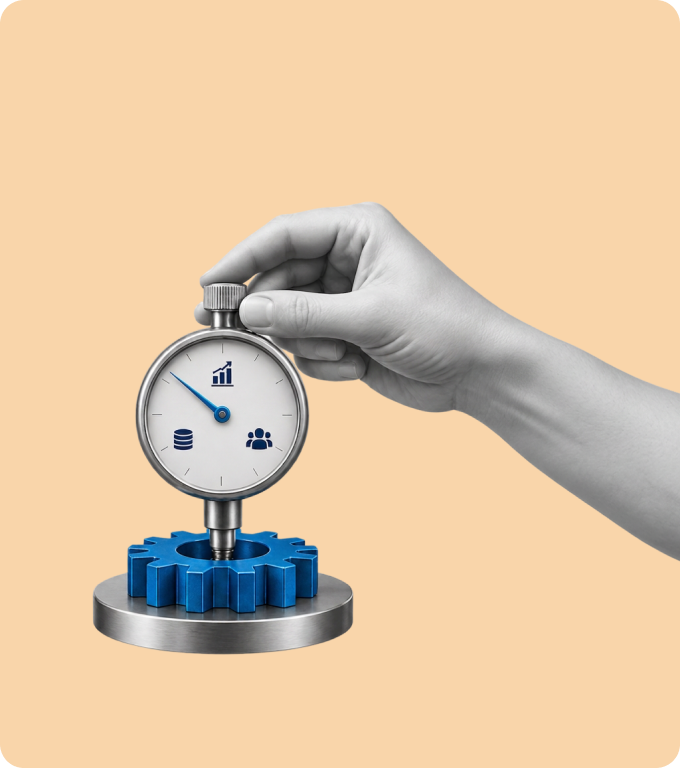
Platforms that opened configuration to non-technical users earlier show what those years look like. Microsoft’s guidance for administrators of its Power Platform states that when a maker leaves an organization, their apps and flows need to be reassigned or they become ownerless. Microsoft had to ship a separate governance kit so administrators could see what their own users had built, because reassignment worked only if someone remembered to do it. monday.com takes a more built-in approach, prompting reassignment at deactivation, but the underlying discipline, someone deciding to do it, still sits with the organization, not the platform.
Retool surveyed 307 chief technology, information and security officers in May 2026. 93% were concerned about AI-built internal tools running in production. Only 4% had governance that covered AI-generated code, whoever wrote it. The industry calls software built this way “vibe-coded.” monday.com uses the same term for its own app builder.
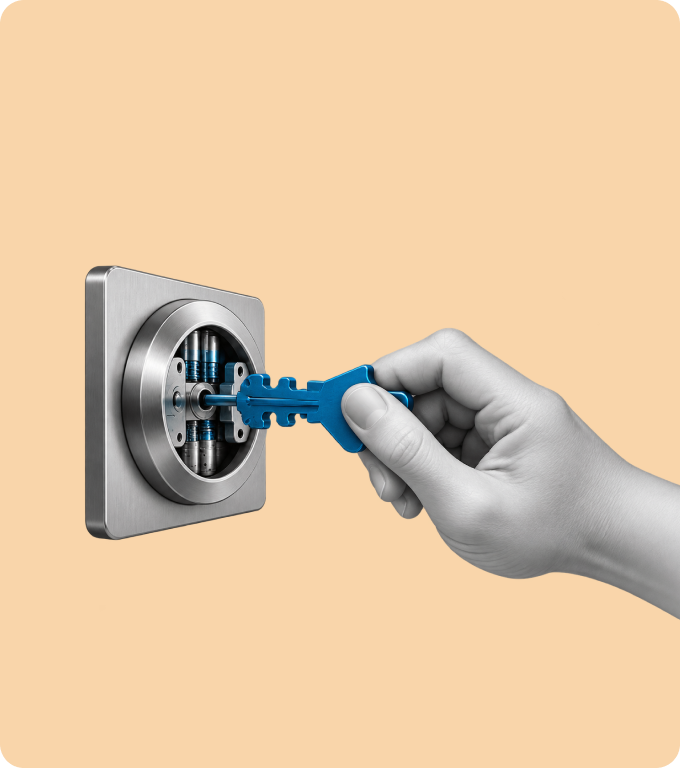
Scale creates the same problem on monday.com. In July 2026, a customer on the Enterprise plan described on the community forum an account with over 6,000 boards that all require the same automations. Ownerless apps, ungoverned AI-built tools, thousands of boards to keep in step: none of these is a gap in the build tools. Each is what happens after the build, at a scale self-service was not designed to manage on its own.
Speed of construction is real, and customers are buying it: monday.com reported that annual recurring revenue from AI products doubled between the first and second quarters of 2026. Durability is a separate outcome, and it depends on what happens after construction. An organization that treats the two as the same thing pays for speed and expects durability without building for it.
03
Durability Now Decides the Deal
The new procurement lens. When anyone can build a workflow, whether it can be built no longer decides the purchase alone. Three other questions do.
When any user can configure a workflow, “can it be built” stops separating one deployment from another. “Will it hold up” does. Three questions decide that, and each is asked about the organization as it will be in a year, not about the feature.
01
Will the workflow stay consistent as the organization grows, reorganizes, and adds teams who never saw the original design?
02
Will it work alongside the other systems the company runs: the CRM (where sales records live), the IT service desk, and the data warehouse that reporting draws from?
03
Will other teams see it, trust it and adopt it as their own, or will they build a rival board?
A well-built workflow can answer the first question for itself. The second and third depend on the systems and teams around it, which no single workflow controls.
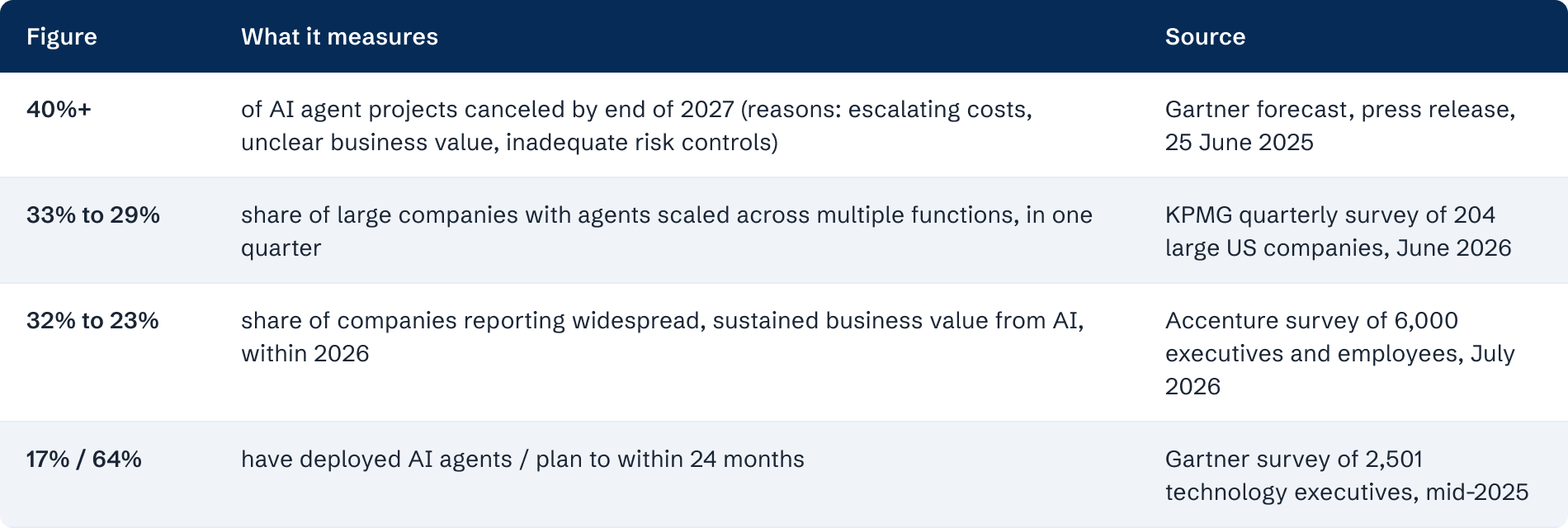
Market data suggests durability, not construction, is where many AI projects run into trouble. Gartner forecasts that more than 40% of AI agent projects will be canceled by the end of 2027. The reasons it cites are escalating costs, unclear business value and inadequate risk controls. None of those represent a failure to build something. Each is closer to a failure to keep something worth keeping.
Gartner also found that 45% of organizations with high AI maturity keep their AI initiatives running for three years or more, against 20% of organizations with low maturity, in a survey of 432 organizations. Accenture found the share of companies reporting sustained, enterprise-wide value from AI fell from 32% to 23% within 2026, in a survey of 6,000 executives and employees. The buying question is whether the workflow is still running in year three.
Visual 1. Projects are not failing on technology. They fail on controls, value and cost, the three things a pilot never has to prove.
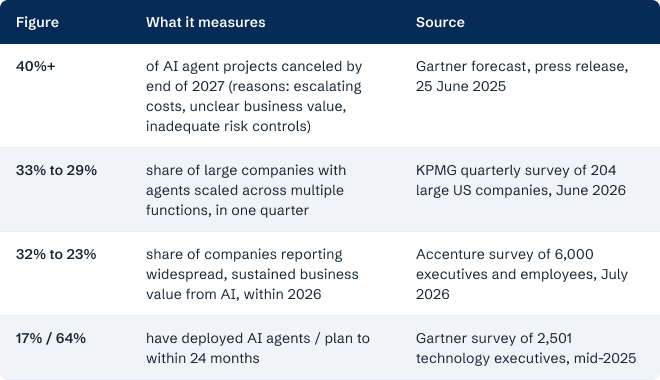
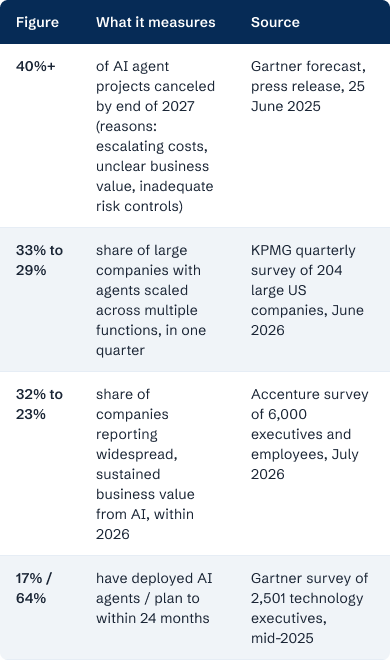
Source: Gartner (2025 and 2026), KPMG (June 2026), Accenture (July 2026). Full citations in Sources.
One caveat on the KPMG figure. The same survey found that the share of organizations orchestrating multiple agents across workflows doubled, from 9% to 18%, in the same quarter, which KPMG reads as consolidation toward fewer, better-coordinated deployments rather than a retreat. Adoption is not stalling. Sustained value is what is slipping.
Most organizations are still between intent and deployment. Gartner’s survey of 2,501 technology executives in mid-2025 found that only 17% had deployed AI agents, while 64% planned to within 24 months. Gartner’s advice to finance leaders in August 2026 is to pilot the governance before scaling the agents, because early pilots most often fail on unclear controls rather than on the technology. A pilot approved on feasibility passes its demo and wins its budget, then fails the durability test after the money is spent.
04
No Single Feature Can Hold the Context Above It
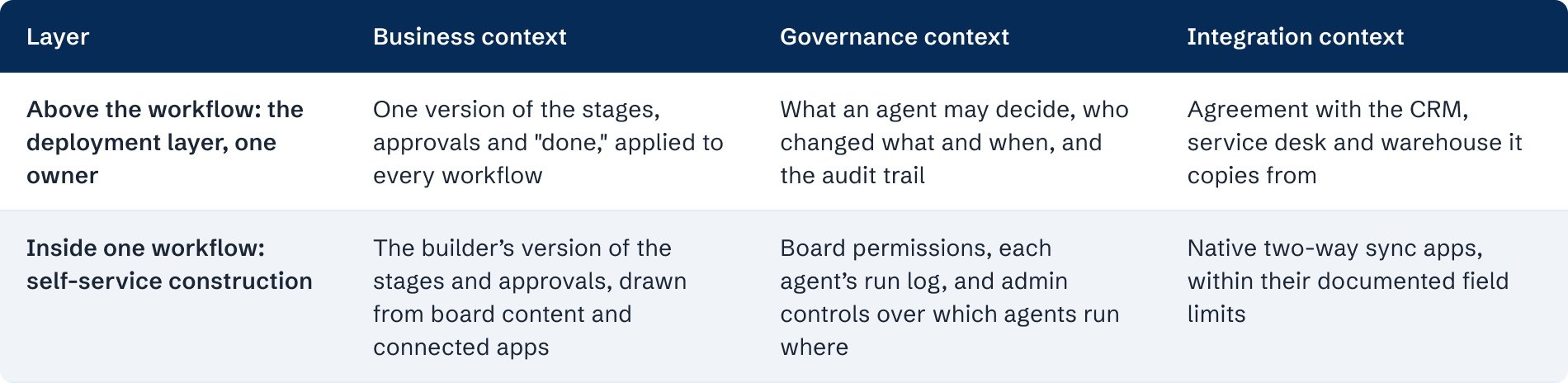
What self-service handles well, and where three kinds of operating context still have to live above any one workflow.
Sidekick and monday’s other AI features draw on real context: board content, connected apps, permissions and activity history. What no feature can decide is which version of that context every team should build to. That is an organizational decision, and it comes in three kinds: business, governance and integration. Inside one workflow, a feature holds its builder’s version of each. The version that has to be the same across every workflow belongs to the organization, and the organization has to hold it somewhere.
One Workflow Becomes Ten Dialects
Business context is what the work means: the real stages a request moves through, the approvals a regulated process requires, and the way Finance and Operations each define “done.” A user who configures a workflow alone encodes their own version of the process. Multiply that across ten teams and the organization has ten dialects of the same workflow, each internally consistent, none of them wrong to the team that built it.
The number of variations is larger than anyone guesses. When Siemens analyzed its order-to-cash process (everything from taking an order to receiving payment), it found 923,000 distinct variants of that one process in that one company. Wil van der Aalst, the researcher who founded the field of process mining, reported “over 900,000 process variants” in the same case. Process mining is software that reconstructs how a process actually ran from the records it left in company systems. Process owners rarely guess anywhere near that. A 2012 practitioner analysis put the gap plainly: they typically estimate “10 or 15” variants, and the real number is “often close to 100.”
The knowledge that would reconcile those variants is mostly held by individuals. A 2018 industry survey estimated that inefficient knowledge sharing costs large US businesses $47 million a year in lost productivity. What gets documented reflects what stakeholders believe to be true. What actually happens is rarely written down anywhere a builder can read it.
What an Agent May Decide, Not Just What It Can Reach
Governance context is who may see a workflow, who may change it, and what record has to exist to defend it later. Self-service generates workflows fast. It generates configuration logs. It rarely generates, on its own, the record of which decisions the organization is willing to let an agent make, as distinct from which data the agent can reach.
On monday.com, permissions on a board control which data an agent can reach. The controls monday.com gives administrators on its Enterprise plan answer the administrator’s questions: which agents run, where, and for whom. Each agent keeps a record of its own runs.
A board’s activity log records what happened on the board, including changes to automations and permissions. It’s a record of what changed, not of whether the organization had decided that change was the one it wanted to allow. A customer asked monday.com in May 2026 for a dedicated log tied specifically to configuration-level changes, distinct from day-to-day board activity. That gap, between logging an action and recording the decision behind it, is what a self-built workflow tends to carry unaddressed.

The stakes of that gap can shift with a single instruction change. The EU AI Act, Europe’s law on AI, was amended in July 2026. Under it, an agent that routes support tickets by queue sits outside the law’s “high-risk” category. Change the agent’s instruction to “assign to whoever closes fastest,” and it now allocates work based on individual performance, a category the law treats differently from December 2027. This example is offered as an illustration of how a small configuration change can shift a workflow’s risk classification, not as legal guidance; organizations should confirm their own obligations with counsel. Whichever side of that line a workflow sits on, that classification is not something the platform records on its own.
Deloitte finds that only 21% of organizations have a mature governance model for AI agents, in a survey of 3,235 leaders. It names the missing capabilities as decision boundaries, real-time monitoring and audit trails. A self-built workflow often has none of those unless someone adds them deliberately.
A Board That Disagrees With Its Source System Is Worse Than No Board
Integration context is about copies. Many monday.com boards hold information that was first entered somewhere else, rather than original data. A sales board often holds a copy of deals that live in the CRM. A support board may hold a copy of tickets that live in the IT service desk. A reporting board may hold figures that also live in the data warehouse. Integration is the work of keeping each copy in agreement with its original. Integration context is knowing which columns are copies, where they come from, and how you would know if they stopped matching.
A board that is out of step with its original is worse than no board, for a simple reason. People trust what they see on the board. Nobody checks a board that looks right, so decisions get made on figures that stopped being true without anyone noticing.
The set of systems a board has to agree with is large and mostly unconnected. The average enterprise now runs 957 applications, and only 27% of them are connected to each other, according to a February 2026 survey of 1,050 IT leaders by MuleSoft. In the same survey, 86% of IT leaders said that without integration, agents add complexity rather than value.
The person who builds a board rarely reads the documentation that sets the limits of a sync. The team that inherits the board does not know which columns stopped agreeing with the CRM. Left as an afterthought, integration costs the platform its credibility the first time two numbers disagree in a meeting.

Visual 2. Each feature holds its own context. None holds the three that sit above it, and those are what a second team inherits.
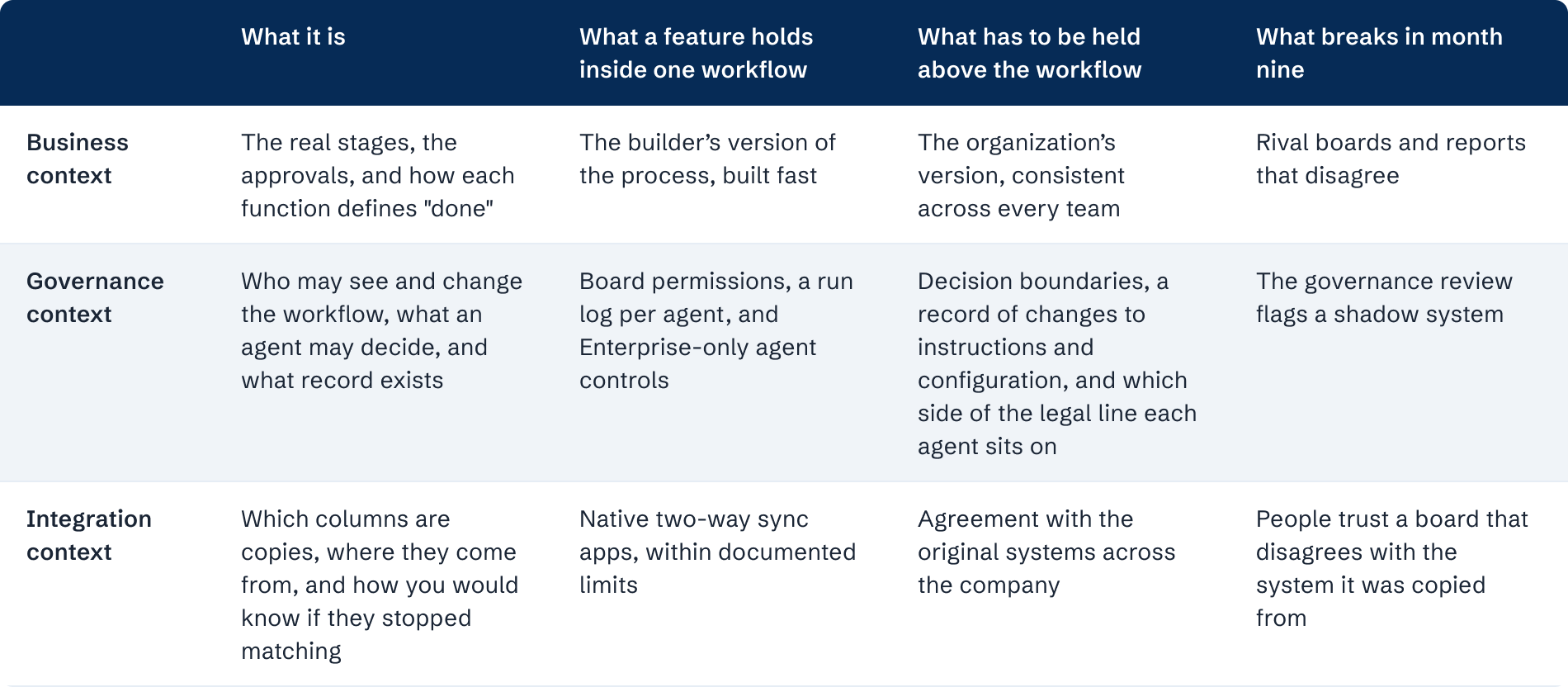
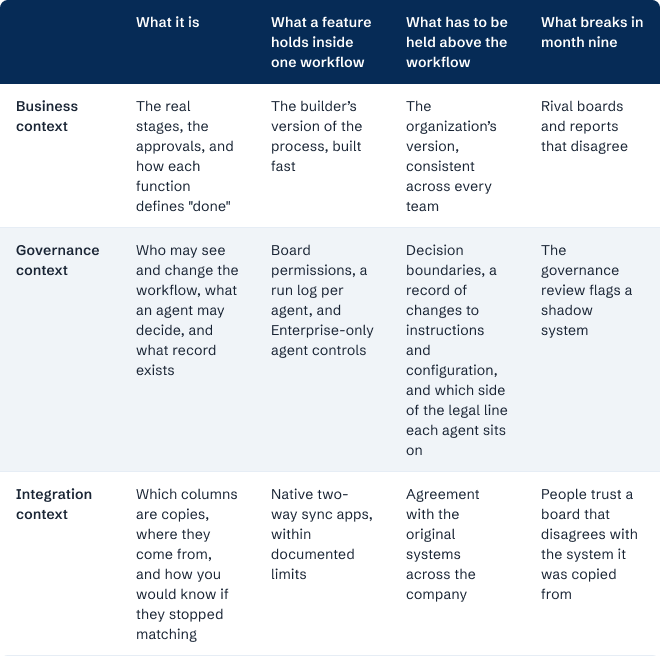
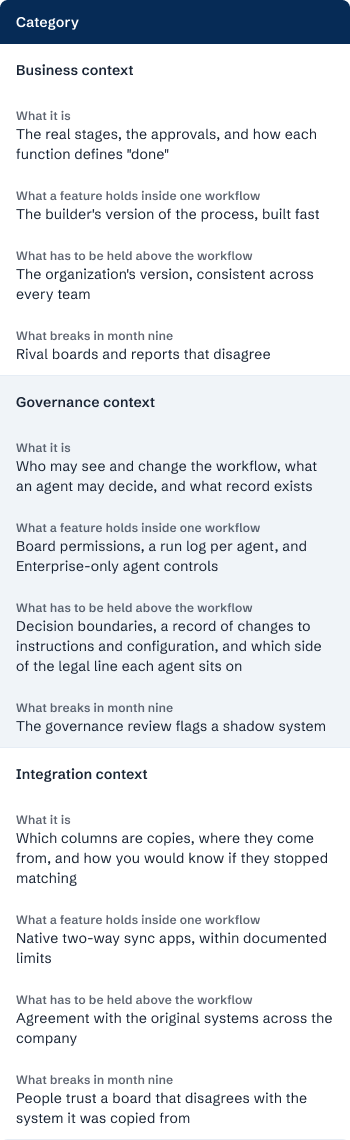
Source: monday.com support documentation (Aug 2026); Celonis and van der Aalst on Siemens; Fluxicon (2012); Panopto/YouGov (2018); Deloitte State of AI 2026; the EU AI Act as amended in 2026; COSO (2026); MuleSoft Connectivity Benchmark 2026. Full citations in Sources.
For the workflows you already run, ask where each of these three kinds of context is held today. Usually the builder holds them by accident, and the administrator’s controls stop at access. Leave them there and each context fails in its own way: ten dialects of a process, an audit finding, and a board nobody trusts.
05
The Failure Is Invisible at Build Time
Nobody edits the workflow. The organization moves and the workflow stays where it was.
Every one of these gaps passes the demo and shows up only at scale, because the pilot’s builder holds the business, governance and integration context in their head. What follows is drift, and drift needs nobody to edit the workflow.
When a builder leaves the company, monday.com prompts for their boards and automations to be reassigned before deactivation. That step is available, but it’s a manual one, and it depends on someone remembering to take it. monday.com’s two-way sync apps, which keep a board and a system such as the CRM updated with each other, can only link fields of the same type. If a linked field’s type changes in the CRM, that specific column silently drops out of the sync, and with it, the connection between the two workstreams it depended on. Nobody on the second team can tell from inside the board that it no longer agrees with the CRM.
Eventually someone asks who changed the agent’s instructions, and when. A customer asked monday.com in May 2026 for a log dedicated to exactly that. Every step in this sequence is ordinary. None of it is visible from inside the board.
Trundl’s own monday.com page describes the same drift in three short lines:
“The rollout stalled at one team. Boards multiplied. Clarity didn’t.”
Trundl, monday.com Work Management page
A monday.com customer described the moment a second team arrives, on the community forum in July 2026. “When it was just our team on monday.com, permissions were simple, everyone saw everything and it didn’t matter. Now that finance, ops, sales, and HR all have their own boards, we’re running into constant requests for ‘can you just give me access to that board’.” Their conclusion, that “giving broad access to keep people happy feels like it’s going to bite us eventually,” is the point where a rollout stalls at one team and a rival board appears.
Visual 3. Nobody edited the workflow. The organization moved and the context stayed with one person.

Source: monday.com support documentation on user deactivation and two-way sync limits (Aug 2026). The events are illustrative.
A workflow is working when a team that never met the builder can run it and defend it. That bar has to be set before the second team takes the workflow on, and self-service does not set it. Someone has to.
06
The Enterprise Question Is Decided at Deployment
The three buying questions are answered at deployment, by whoever owns it.
Deployment is where a workflow meets the rest of the organization: its people, its policies and its other systems. It is where business context gets applied consistently, where governance is either present from the start or retrofitted later, and where the connections to other systems either hold or quietly break. monday.com’s AI handles construction well and governs its own platform well. The version of business, governance and integration context that has to stay consistent as the organization changes is a decision the organization makes, and deployment is where it gets made.
An engineering problem has an owner. Someone has to set the rules every workflow follows, decide what an agent may decide, and keep each board in agreement with the system it was copied from. Naming that person, before the next workflow goes live, is the decision that separates a platform other teams standardize on from a collection of fast-built boards.
monday.com’s own leadership has pointed at the same layer. On its second-quarter earnings call in August 2026, Co-CEO Eran Zinman told investors that “customers want to adopt AI, but a lot of them don’t know how to do it.” The company said it would expand the engineering teams it places directly with customers to close that gap.
“Owning context, where data and conversations live, is the differentiator and key to winning AI-driven work.”
Patrick Howell, Co-CEO, Trundl
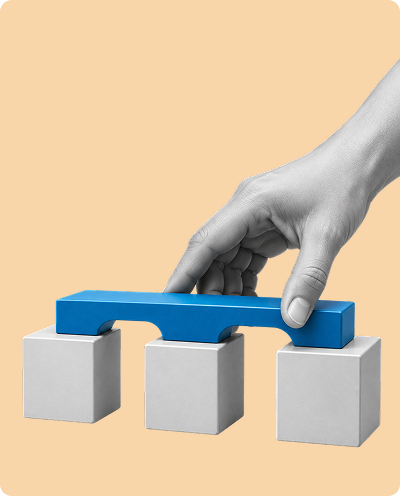
Visual 4. Self-service builds inside a workflow. The three buying questions are answered in the layer above it, where the organization decides what stays consistent across every workflow.
Source: Trundl analysis.
Without a named owner, monday.com is adopted one team at a time and standardized on by none.
None of this is an argument for slowing down the AI in monday.com. Agents, Sidekick and vibe collapse the cost of construction, and that is worth having. Pairing that speed with a deliberate approach to deployment answers the questions buyers now lead with: will it hold up, will it keep up, and will other teams make it their own.
07
Start From How the Work Already Runs
A delivery model that reads the business as it actually operates and builds governance in with the configuration.
A durable deployment starts from the organization’s real environment. The inputs are the configurations it already has, the documents it has already written, and the transcripts of the conversations where the rules were agreed. The output is a configuration generated from how the organization actually works. Trundl calls this approach Contextual Delivery: an operating model that turns business context into production-ready systems, governed by design.

The Input Is What the Organization Has Already Written Down
On monday.com, every Trundl engagement starts from how the work already moves. Templates are used where they fit, but most of the build comes from the organization’s own documentation. That is what lets one deployment carry a single version of the business context across every workflow, where self-built boards carry ten.
Governance Built In at Configuration Time
Governance is strongest when it is generated during the build rather than retrofitted after deployment. When a workflow ships with the audit record needed to defend it, and access rules and change control are produced as part of configuration, it holds up under scrutiny.
On monday.com, that means workspace structure, permissions and ownership are set before the account grows, documented, and reviewed at handoff. AI agents and assistants are configured on your boards, within your guardrails, as part of the build.
COSO, the body whose framework most internal-control audits follow, asks for the same record in its 2026 guidance on AI: logging of instructions, inputs and approvals, with change control over configuration. A workflow that carries that record from the day it is built is far better positioned for the review it will eventually face, though no configuration can guarantee the outcome of a future audit.
monday.com Stays Connected to the Systems Around It
A durable deployment treats monday.com as one platform among the others the company runs. Information has to stay in agreement between monday.com and the systems it copies from, across monday Work Management and whichever other monday products the customer runs, while teams keep working at their own pace. Which columns are copies, and whether they still match, has to be a managed part of the deployment rather than something the second team discovers.
For teams moving to monday.com from another tool, Trundl moves data and workflows into monday Work Management with connectors to tools such as Smartsheet and Asana, without a single switch-over weekend. The builds themselves are mapped from the customer’s process and configured by Trundl.
The Business Validates Every Step
AI runs across the whole engagement. The organization’s own people validate each step as it is built, so inefficiencies in the existing process get surfaced and discussed rather than copied forward. That review is what separates a workflow nobody checked from a configuration the business has already tested against reality.
AI handles construction and people keep the business decisions, which keeps the speed of self-service without its blind spots. Trundl runs no unsupervised automation in customer environments, and its data-handling practices are published in its Trust Center.
The workflows that have to spread beyond one team need a delivery model chosen for them. Not choosing one means paying twice: once to build fast, and again to rebuild under audit.
08
Twelve Questions Before a Second Team Inherits a Workflow
Every “no” is a piece of context the builder still carries in their head.
Take one workflow a second team is about to inherit and answer these twelve yes-or-no questions honestly, with the builder in the room. They are grouped by the three kinds of context in Section 04, and every one points at something a builder can hold in their head and a second team cannot.
The Deployment Readiness Check. Twelve questions to ask about a workflow before a second team inherits it.
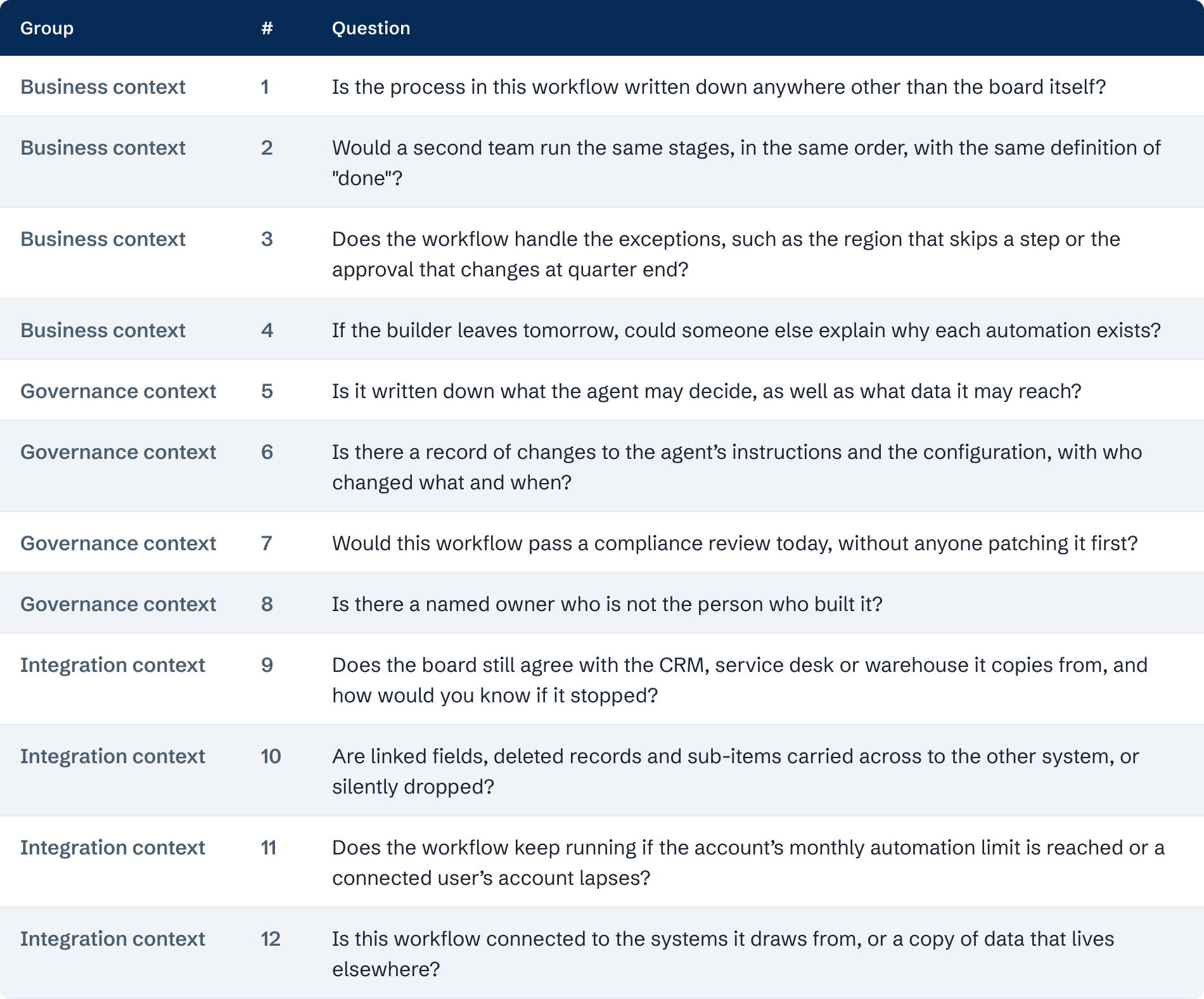
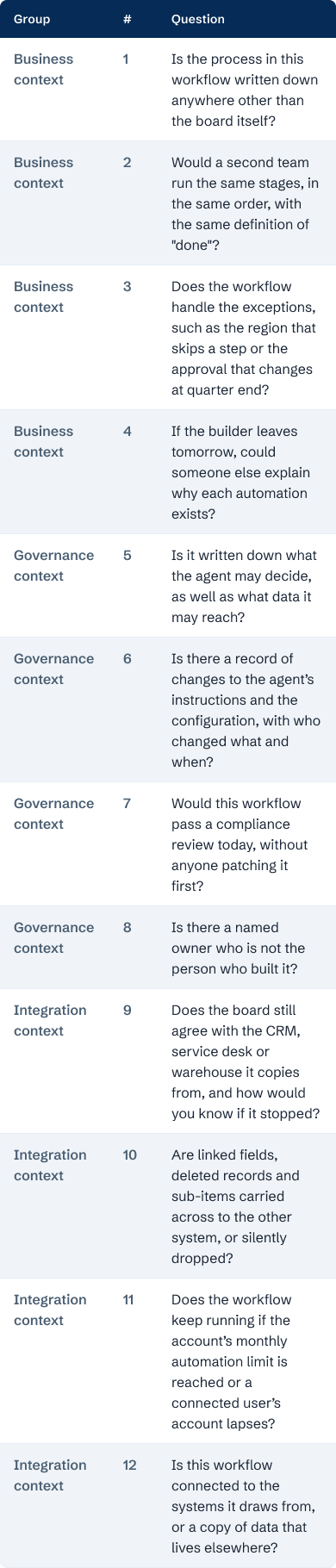
Four or more “no” answers is a signal the workflow still depends on the person who built it, not on anything the organization has made durable. Skip the check and the same answers turn up in the governance review, after the second team has built around them.
Trundl structures pricing around the outcome the platform investment delivers, not simply around hours logged.
Book a scoping call
Thirty minutes on your process, and a clear next step. No deck and no obligation, just a practical recommendation.
Appendix: Sources
Numbered in order of first appearance. Every inline citation in the paper has an entry here.
1.
monday.com Goes All In on AI: From Work Management Platform to AI Work Platform. monday.com investor relations, press release. 6 May 2026. https://ir.monday.com/news-and-events/news-releases/news-details/2026/monday-com-Goes-All-In-on-AI-From-Work-Management-Platform-to-AI-Work-Platform/default.aspx. Vendor launch language.
2.
Activity Log for Automations & Integrations (feature request). Wiwin, community.monday.com. 14 May 2026. https://community.monday.com/feature-requests/post/activity-log-for-automations-integrations-iYyrCufwfzNKVq6. Community post, named author; asks for a “dedicated activity log that tracks administrative or configuration-level changes made to automations and integrations”.
3.
monday.com pricing page (vibe: “Turn any business need into a custom business app in minutes”). monday.com. fetched 24 August 2026. https://monday.com/pricing. Vendor marketing.
4.
Get started with monday sidekick. monday.com support. last modified 13 August 2026. https://support.monday.com/hc/en-us/articles/26701503726610-Get-started-with-monday-sidekick. Vendor documentation.
5.
Get started with monday vibe. monday.com support. last modified 24 August 2026. https://support.monday.com/hc/en-us/articles/28451758349842-Get-started-with-monday-vibe. Vendor documentation; “private by default” wording confirmed on https://monday.com/w/vibe, fetched 24 August 2026.
6.
AI Agents on monday.com. monday.com support. last modified 20 August 2026, re-fetched 25 August 2026. https://support.monday.com/hc/en-us/articles/33347027353746-AI-Agents-on-monday-com. Vendor documentation.
7.
Manage the default environment (Power Platform guidance). Microsoft Learn. updated 23 June 2026. https://learn.microsoft.com/en-us/power-platform/guidance/adoption/manage-default-environment. Vendor documentation.
8.
The State of AI Governance in 2026. Retool, with Wynter. published 17 June 2026; fielded May 2026. https://retool.com/blog/ai-governance-report-2026. n=307 senior technology and security leaders, all CTO, CIO or CISO titles; vendor-published.
9.
Workspace-Level and/or Account-Level Automations for Enterprise Customers (feature request). Amy Morrow, community.monday.com. 24 July 2026. https://community.monday.com/feature-requests/post/workspace-level-and-or-account-level-automations-for-enterprise-customers-gRKGIZZrhfstG1z. Community post, named author.
10.
monday.com Announces Second Quarter 2026 Results (“ARR from AI products doubled from Q1, representing 17% of net new ARR in Q2”). monday.com investor relations, press release. 10 August 2026. https://ir.monday.com/news-and-events/news-releases/news-details/2026/monday-com-Announces-Second-Quarter-2026-Results/default.aspx. Company results; co-CEO statement in the release text.