


Enterprises have spent years accumulating software. Now, growing costs, fragmented workflows, and the demands of AI are forcing them to rethink their technology portfolios. Contextual Delivery platforms offer a faster, more economical path to consolidation, modernization, and a connected system of work.
Enterprise Software Has Become Easier to Buy Than to Leave Behind
Tool sprawl is not a strategy. It accumulates through years of decisions that make sense individually but create complexity collectively.
Mergers and acquisitions bring entire technology estates. M&A introduces overlapping applications, competing workflows, redundant licenses, and disconnected systems of record. Integrating these estates often takes a back seat to more immediate business priorities.
Procurement bends to departmental demand. Business units purchase specialized tools to solve immediate problems. Marketing adopts one work management platform, program teams another, and IT ops a third. Each addresses a legitimate need, but few account for the enterprise-wide consequences.
Decentralized IT accelerates fragmentation. Cloud applications let departments operate independently. Yet without consistent governance and architectural oversight, organizations gradually accumulate disconnected platforms, integrations, and data.
The result is an enterprise where work is distributed across dozens of applications, each representing a different piece of how the business operates. The challenge is that the business has become fragmented across them.
Why Enterprise Tool Sprawl Has Become a Strategic Problem
For years, app rationalization was primarily a cost-containment exercise. Today, high cost is one of many consequences of tool sprawl.
Higher operating costs. Redundant subscriptions, administration, support, training, and integration maintenance increase technology spending per employee. The true cost of an application extends well beyond its annual license.
Disconnected workflows. While some apps provide great task boards and isolated workflows, work still moves between departments through chat, emails, spreadsheets, manual updates, and disconnected integrations. More time is spent in data reconciliation than advancing outcomes.
Growing IT oversight burdens. Every additional platform introduces another set of users, permissions, configurations, vendor relationships, integrations, and security requirements.
More complex governance, risk, and compliance. Fragmented systems make it harder to enforce consistent policies, maintain audit trails, govern sensitive information, and demonstrate regulatory compliance.
Budget pressure. Enterprises are scrutinizing software portfolios more closely, looking beyond license utilization to identify opportunities for consolidation and operational efficiency.
The need to become AI-ready. AI-powered collaboration depends on access to relevant organizational knowledge, connected workflows, and trustworthy business context. Fragmented systems can limit the usefulness of enterprise AI by scattering information across disconnected environments.
These pressures are changing the objective of application rationalization. It’s no longer enough to eliminate redundant licenses. Companies need to create a more connected, governable, and adaptable system of work.
Three Strategies for Rationalizing Enterprise Applications
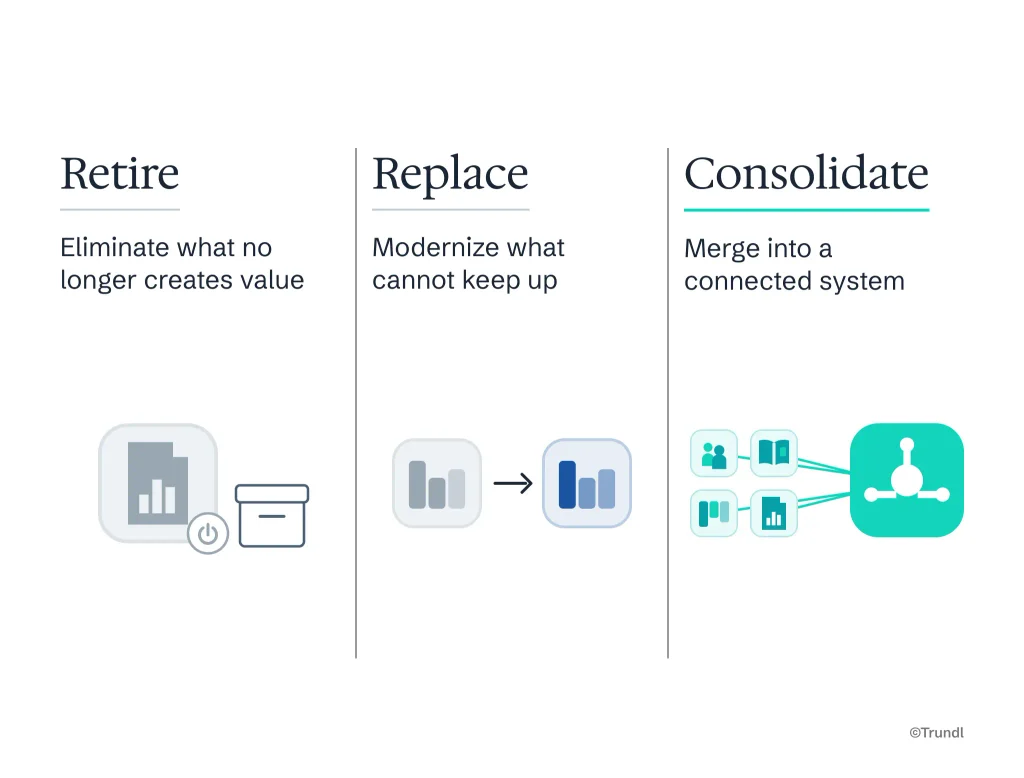
App rationalization generally involves three strategic choices: retire, replace, or consolidate.
1. Retire: Eliminate What No Longer Creates Value
Apps outlive their usefulness over time.
They may be redundant, obsolete, underutilized, or no longer aligned with business requirements. Retiring them reduces licensing costs, administrative overhead, and unnecessary complexity.
However, retirement doesn’t necessarily mean deleting everything. Historical records, audit evidence, and business-critical information may need to be preserved. Data archiving and retention strategies allow organizations to eliminate unnecessary applications without sacrificing access to important information.
2. Replace or Replatform: Modernize What Can No Longer Keep Up
Other apps remain essential to the business but are no longer suitable for its future.
They may be approaching the end of their support lifecycle, difficult to integrate, expensive to maintain, or unable to meet modern security, governance, and AI-readiness requirements.
Organizations must move business capabilities to more appropriate platforms.
But replacement is rarely a simple data-transfer exercise. The existing app may contain years of custom workflows, business rules, permissions, dependencies, and institutional knowledge. Successful replatforming requires understanding what the organization does today, and determining what should change in the future.
3. Consolidate and Modernize: Build Around a Connected System of Work
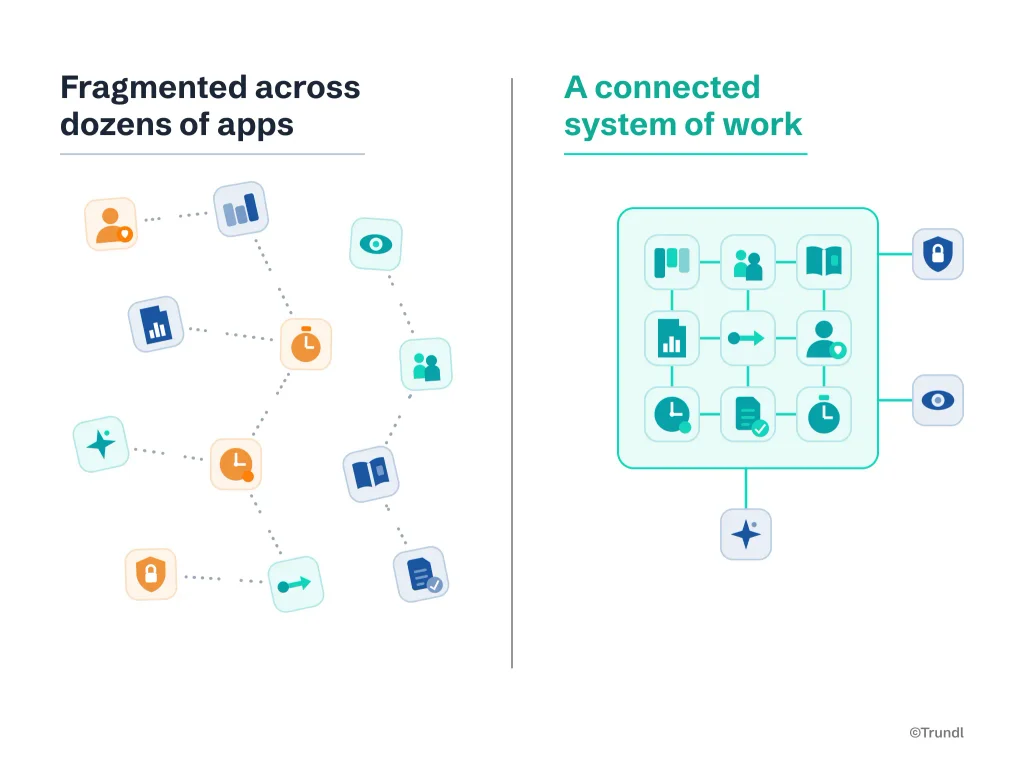
The most strategic approach is often to consolidate overlapping applications into a smaller number of enterprise-wide platforms.
Rather than maintaining separate tools for project management, service delivery, collaboration, knowledge management, and operational coordination, organizations can establish a more unified system of work.
Departments do not all have to move into one application. The aim is a connected operating environment where common workflows, data, governance, and collaboration capabilities work together.
For example, an organization might consolidate several departmental work management platforms into Atlassian (one of the few SaaS platforms able to serve as a system of work, including Jira, Confluence, and Jira Service Management) while preserving specialized systems that remain valuable and integrating them into the broader enterprise environment.
The objective is migration plus modernization: using the transition to improve how work is coordinated, measured, and governed.
If the Benefits Are Clear, Why Does Tool Sprawl Persist?
Most enterprises already understand the advantages of app rationalization. The obstacle is execution.
Changing Deeply Entrenched Human Behavior
Employees become comfortable with familiar interfaces, processes, terminology, and ways of working.
A platform may be technically replaceable but operationally indispensable to the people who use it every day. Organizations must account for training, adoption, resistance to change, and the institutional knowledge embedded in established workflows.
Complex Technical and Organizational Dependencies
Enterprise applications rarely operate independently. They connect to identity systems, reporting environments, databases, integrations, automations, and downstream business processes.
A seemingly straightforward migration can reveal dependencies that were never formally documented.
Organizations Lack the Context Needed to Act
Many companies don’t have a complete understanding of how their apps are configured or why they operate the way they do.
Documentation is incomplete. Custom workflows have evolved over years. Key decisions may exist only in the knowledge of a few employees.
Without this context, transformation becomes a prolonged exercise in discovery, interviews, requirements gathering, and manual reconstruction.
Platform Lock-In Makes Change Feel Too Risky
Organizations often remain with incumbent platforms because replacing them appears more expensive or disruptive than continuing to operate them.
Proprietary configurations, custom automations, integrations, and established user behavior create switching costs that extend far beyond software licensing.
Some constraints are genuinely technical or contractual. Others arise because traditional migration approaches require organizations to manually rediscover and rebuild everything they already know.
The result is a paradox: organizations continue paying the cost of fragmentation because eliminating it appears even more expensive.
The Biggest Barrier Is Time to Value
Traditional app rationalization is a substantial undertaking.
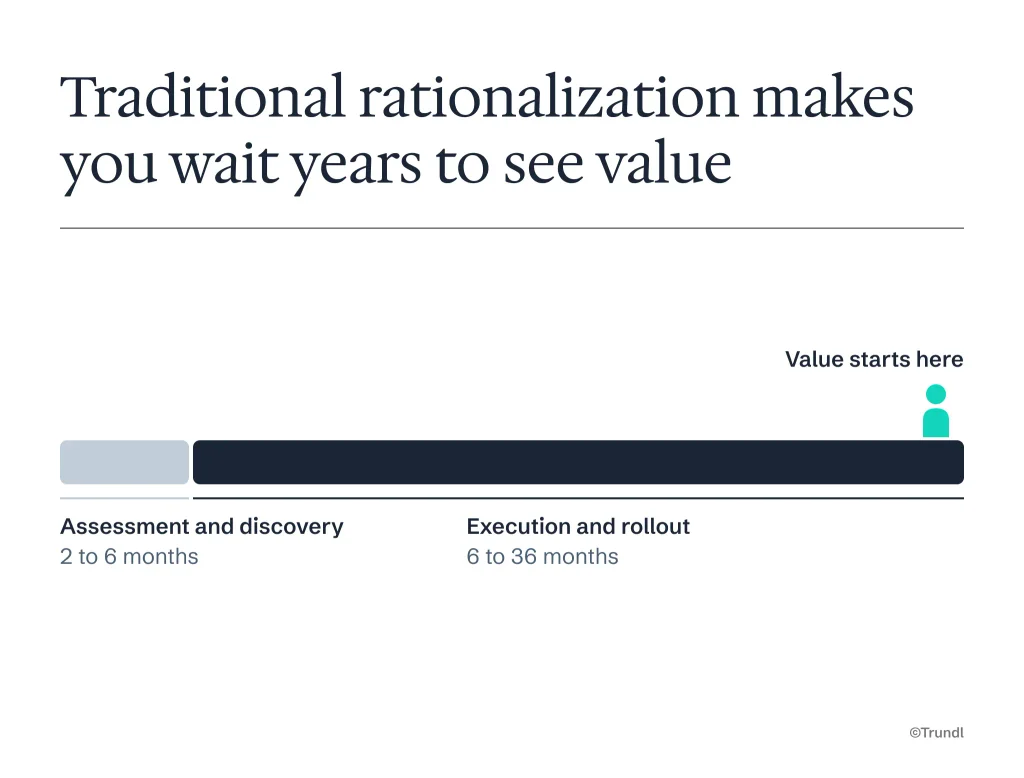
For a large enterprise, a transformation program might involve:
| Phase | Typical Activities |
|---|---|
| Assessment and discovery | Application inventory, usage analysis, dependency mapping, stakeholder interviews, target-state planning |
| Execution and rollout | Migration, configuration, integrations, testing, training, adoption, and decommissioning |
The industry-wide average for time to value for enterprise SaaS solutions is 3 to 18 months.
Financial justification is one thing. Putting the work and time into realizing transformation is another, especially when businesses must “keep the juggling show going.”
Business priorities change. Project budgets shift. Stakeholders move on. Requirements evolve before the new environment is ready.
The longer transformation takes, the longer the organization waits to realize its benefits.
Contextual Delivery: Changing the Economics of Transformation
Traditional enterprise delivery relies heavily on people manually translating business requirements into technical implementations.
Teams conduct discovery workshops, document processes, design target environments, configure platforms, test workflows, and refine solutions through successive implementation cycles.
Much of this work involves reconstructing information that already exists somewhere in the organization.
Contextual Delivery introduces a fundamentally different approach.
Rather than beginning with a blank implementation project, Contextual Delivery uses existing organizational context, including app configurations, process documentation, workflows, business rules, data structures, and stakeholder knowledge, to accelerate the creation of working target environments.
AI-assisted discovery, configuration, migration, and validation help compress activities that traditionally require extensive manual effort.
This changes three critical aspects of application rationalization.
1. Discovery Becomes an Accelerator, Not a Bottleneck
Organizations can use existing app configurations and business documentation as inputs to the transformation process.
Instead of relying exclusively on interviews and manual requirements gathering (which usually takes weeks or months), Contextual Delivery approaches translate existing operational knowledge into actionable configuration and migration requirements.
The result is a faster path from understanding the current environment to designing its replacement.
2. Organizations Validate the Future Earlier
Traditional projects often require significant investment before users can interact with the proposed solution. Contextual Delivery enables teams to create working prototypes and target environments earlier in the process.
Stakeholders evaluate familiar workflows, test business scenarios, and identify necessary changes before committing to a broader rollout.
This changes the conversation from “Will this new platform work for us?” to “What should we refine before we deploy it?”
3. Transformation Becomes More Iterative and Less Disruptive
App rationalization does not always require a single, enterprise-wide cutover.
The Contextual Delivery model lets organizations progressively consolidate platforms, synchronize environments during transition, migrate selected workflows, and validate outcomes in stages.
This creates opportunities to reduce migration risk while allowing the enterprise to realize value incrementally.
Most importantly, it enables organizations to modernize workflows rather than merely recreate outdated processes on new platforms.
Pioneering Contextual Delivery: Trundl and Rapid Deploy
One company advancing this delivery model is Trundl, an Atlassian Solution Partner founded in 2014, with operations in the United States, Canada, and India.
Through its work helping enterprises consolidate fragmented tooling into connected systems of work, Trundl identified a persistent disconnect: enterprise software was evolving rapidly, but the methods used to implement and transform it remained heavily manual.
In late 2025, Trundl released Rapid Deploy, its foundational Contextual Delivery engine, designed to accelerate the creation of working enterprise SaaS environments from existing business context. Rapid Deploy drives AI-assisted discovery, deployment, synchronization, migration, and validation, all in one engine.
Rather than automating individual implementation tasks, Rapid Deploy translates organizational knowledge into working platform configurations, allowing enterprises to test and refine future operating models earlier in the transformation process.
The objective is to reduce the cost, time, and uncertainty traditionally associated with enterprise software change.
Toshiba Global Commerce Solutions: Rationalization Without Reinvention
A practical example comes from Toshiba Global Commerce Solutions, which needed to consolidate its hardware commercialization workflows from Smartsheet into its broader enterprise Atlassian environment.
Toshiba’s Smartsheet environment supported specialized processes across hardware engineering and commercialization teams primarily based in Taiwan. Replacing it meant more than moving tasks and records. The new environment needed to preserve familiar project structures, terminology, workflows, and cross-functional coordination while providing better integration with the company’s enterprise systems. This was critical for team adoption and work continuity.
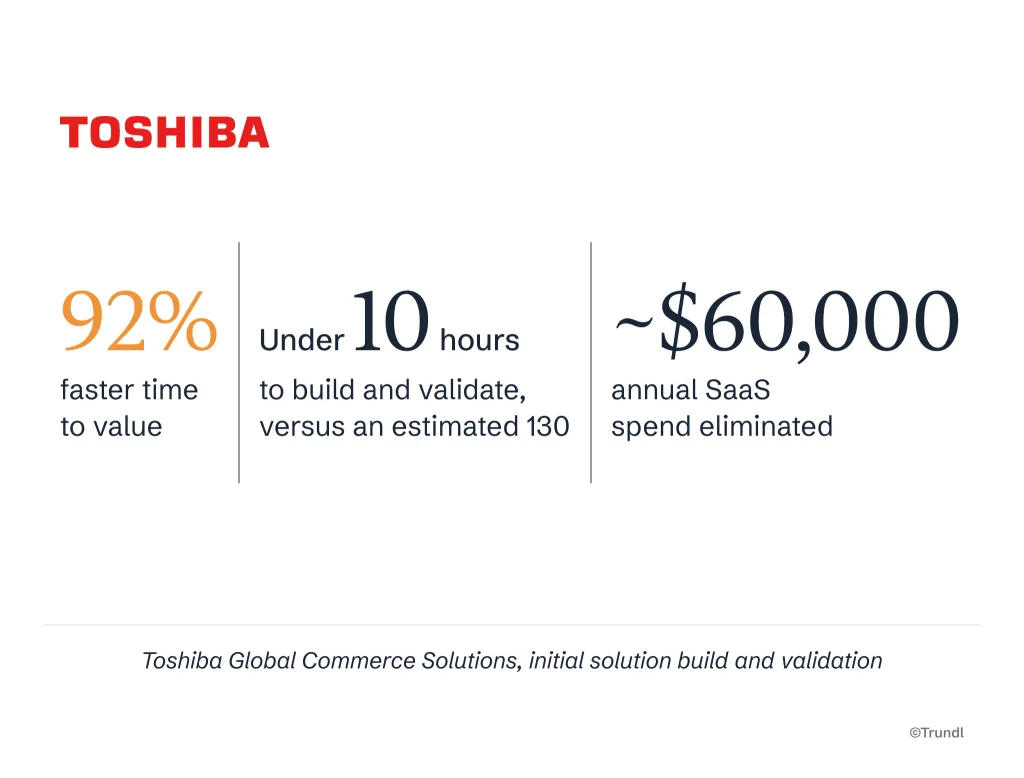
If a traditional approach had been applied, Trundl estimated that recreating this environment would take 130 hours of implementation effort and four weeks to user acceptance testing.
Using Trundl’s Rapid Deploy engine, the initial working solution was recreated and validated in less than 10 hours of total effort.
By the second meeting, Toshiba’s stakeholders were testing their custom Jira implementation in a sandbox environment that reflected familiar business processes, labels, and structures, rather than spending weeks reviewing requirements and waiting for manual configuration in Jira.
The business impact extended beyond implementation speed.
By consolidating the Smartsheet environment into its existing enterprise Atlassian ecosystem, Toshiba was able to establish a more connected operating environment for its hardware teams.
The case illustrates two dimensions of value:
Accelerated delivery: 92% less effort. Work estimated at 130 hours took under 10, and testing started by the second meeting instead of after four weeks.
Operational modernization: portfolio rollups from day one, and a foundation for earned value, capacity planning, and reporting.
These figures describe Toshiba’s initial solution build and validation, not the completion of all historical data migration or an enterprise-wide production rollout. Results are specific to this engagement.
What makes the example significant is how little implementation effort the consolidation required. Historically, tool lock-in meant substantial investments in professional services before realizing the financial benefits of application consolidation.
When an enterprise recreates and validates its operating environment dramatically faster, the economics of retiring redundant software become more attractive, and the business can begin realizing the benefits of rationalization sooner.
SaaS Lock-In Is No Longer Just a Technical Question
For years, organizations have treated platform switching costs as an unavoidable consequence of enterprise software. But many of those costs arise from the way transformation has traditionally been delivered. Contextual Delivery challenges that assumption.
It does not eliminate legitimate technical dependencies, contractual restrictions, or the complete human effort required for organizational change. It does, however, create the possibility of substantially reducing the work required to understand, reconstruct, validate, and evolve enterprise operating environments.
When the cost of change falls, enterprises gain greater freedom to choose the platforms that best serve their business.
The Future: More Adaptable Enterprises
The future enterprise won’t necessarily operate on a single application.
Manufacturers will still need specialized production systems. Financial institutions will retain purpose-built transaction platforms. Healthcare organizations will continue relying on clinical applications.
The objective is to eliminate unnecessary fragmentation while keeping the specialization each business needs. That means retiring apps that no longer create value, replacing platforms that constrain innovation, consolidating overlapping capabilities, and connecting specialized systems into a coherent enterprise operating model. Contextual Delivery is driving time to value in that respect.
Through innovations such as Trundl’s Rapid Deploy, enterprises can increasingly use their existing organizational knowledge to accelerate how systems are designed, deployed, migrated, and modernized.
And as examples like Toshiba Global Commerce Solutions demonstrate, the opportunity is not merely theoretical. Faster delivery can make application rationalization more financially attractive while helping organizations build more connected systems of work.
Ready to rethink your application portfolio?
Discover how Contextual Delivery, powered by Trundl’s Rapid Deploy, can accelerate SaaS rationalization, platform consolidation, and enterprise work transformation.