


A practical read on Atlassian’s usage-based pricing, and how to get ahead of it.
Somewhere in your organization, a finance teammate just heard that Atlassian pricing is changing, and started drafting the email you do not want to read in January.
That email is avoidable. Not by ignoring the change, and not by panicking about it either.
Atlassian has moved part of its platform to usage-based pricing. Seats stay. On top of them sits a usage layer for the things that scale with how much work you ask the platform to do, led by AI.
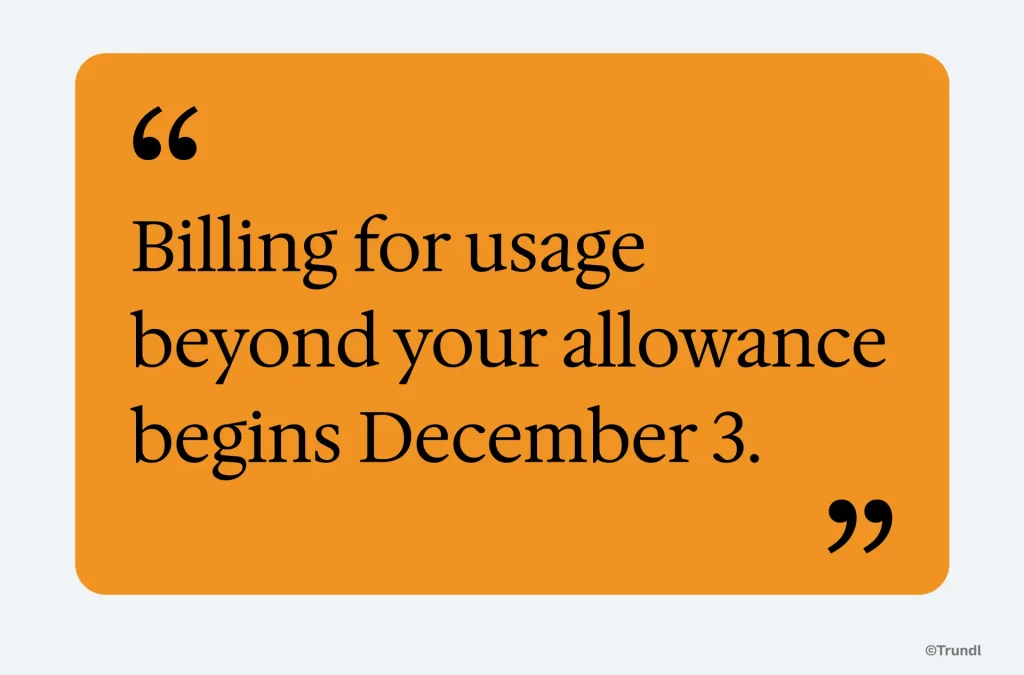
Most plans include real allowances, and billing for anything beyond them does not begin until December 3.
This is an operating-model change wearing a pricing announcement’s clothes
Here is the part worth slowing down for.
Yesterday, your AI usage was effectively free and invisible. Today it has a meter, a dashboard, and a bill attached. Someone now owns a discipline that did not exist before: deciding how much metered work your teams and your agents should do, and watching it happen.
That is not a tax. It is the same shift every platform is making as AI does more of the work. The teams who treat the next ninety days as a governance project will spend less, and sleep better, than the teams who treat it as a pricing argument.
What it does to your AI
Start with the question everyone is really asking.
Rovo credits are the headline. They now cover the AI features you know, and something quieter: the enriched calls that reach across your tools to assemble an answer. A simple lookup inside one product stays free. The work that draws on the meter is the reaching, pulling across Jira, Confluence, and the systems wired to them, then ranking and filtering what comes back. You are not paying for the answer. You are paying for the reach behind it.
Automation is the one more teams will feel, and the one most will underestimate. It now counts the steps inside each rule, not just the run, so a busy rule with branches and loops counts for far more than it used to. If you have rules firing on a schedule all day, that is where a quiet bill grows.
The rest matter less for most teams, but know they are there. Assets now meters the objects you store, and reaches more of the platform. Bitbucket’s meters move into one place. And in Customer Service Management, you are charged only when an AI agent resolves a request end to end with no human behind it, which is the fairest shape of the group.
The meter is on the reach, not the tool
Now the part almost everyone will miss.
Send an enriched request through Rovo, through the MCP server, through the command line, or through an outside assistant like Claude or Copilot, and the metered event underneath is the same event. The front end is your choice. The reach is the cost.
So your lever is not which AI you standardize on. It is which agents and which people are allowed to reach across which of your systems, and how often. That is a governance question, and it is the one that decides your bill.
The work worth doing before December 3
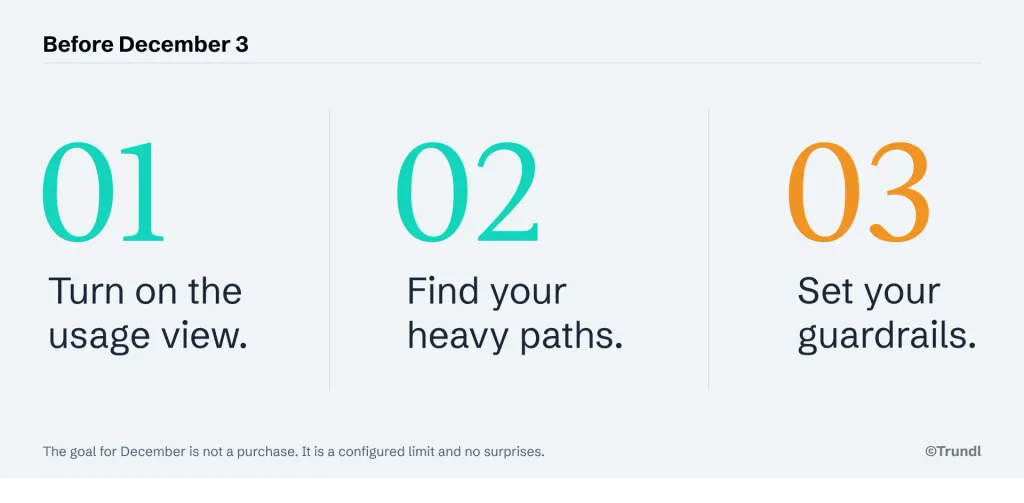
Turn on the usage view in Atlassian Administration and read it. Your pattern is the only one that matters, and it will not look like the vendor’s examples or your neighbor’s. Watch where the credits and steps gather for a few weeks before you decide anything.
Then find your heavy paths. The scheduled automations, the fan-out rules, the agents that loop across the graph, the enriched calls that run all day. That is where cost concentrates, and where a small change pays for itself.
Then set the guardrails on purpose. Decide which approved models can reach which data, put ceilings on the meters that need them, and cap or disable extra usage where you would rather stop than pay. The goal for December is not a purchase. It is a configured limit and no surprises.
How we help
This is the work we do at Trundl every day, so here is the concrete version. You can do any of it with us or without us.
We start by reading your usage the way you would read a P&L. Which meters are moving, which teams and agents are driving them, and which automations and enriched calls are the heavy ones. That assessment is the whole of our scoped AI² session: bring one workflow where AI is already running, and you get back a clear picture of your exposure, a configuration, and a timeline, with no commitment attached.
From there the work is governance, and it is specific. We set which approved models, Rovo, Claude, Copilot, or others, are allowed to reach which of your systems, and we mirror your existing permissions so nothing over-reaches. We put ceilings on the meters that need them and configure the alerts and caps in Atlassian Administration so extra usage stops where you want it to. We rationalize the automations that quietly ballooned under step counting. And we put an owner and an audit trail on every AI contribution, so you can answer for it later. That governed setup is what our Rapid Deploy engine stands up in days, built from the systems you already run, instead of a quarter-long project.
Then, because governance decays the moment it is left alone, Trundl Managed Services keeps it running. Watching the meters as your usage moves, adjusting limits and automations, and holding agents inside the guardrails you set.
We measure ourselves on one thing here, and it is not seats sold or packs pushed. It is whether the meter ever catches you off guard.
The point
None of this is about paying Atlassian less for its own sake. AI that reaches across your work is worth paying for. What changed is that the reach now has a price, and the price rewards the teams that govern it.
So do the unglamorous thing. Turn on the dashboard, learn your own pattern, and set your limits, and decide who can reach what. Make December a non-event.
AI tools helped research, develop, draft, and refine this piece. The ideas, structure, judgment, and responsibility for what it says belong to the author. AI helped get past the blank page and supported the work that followed. The thinking is human.