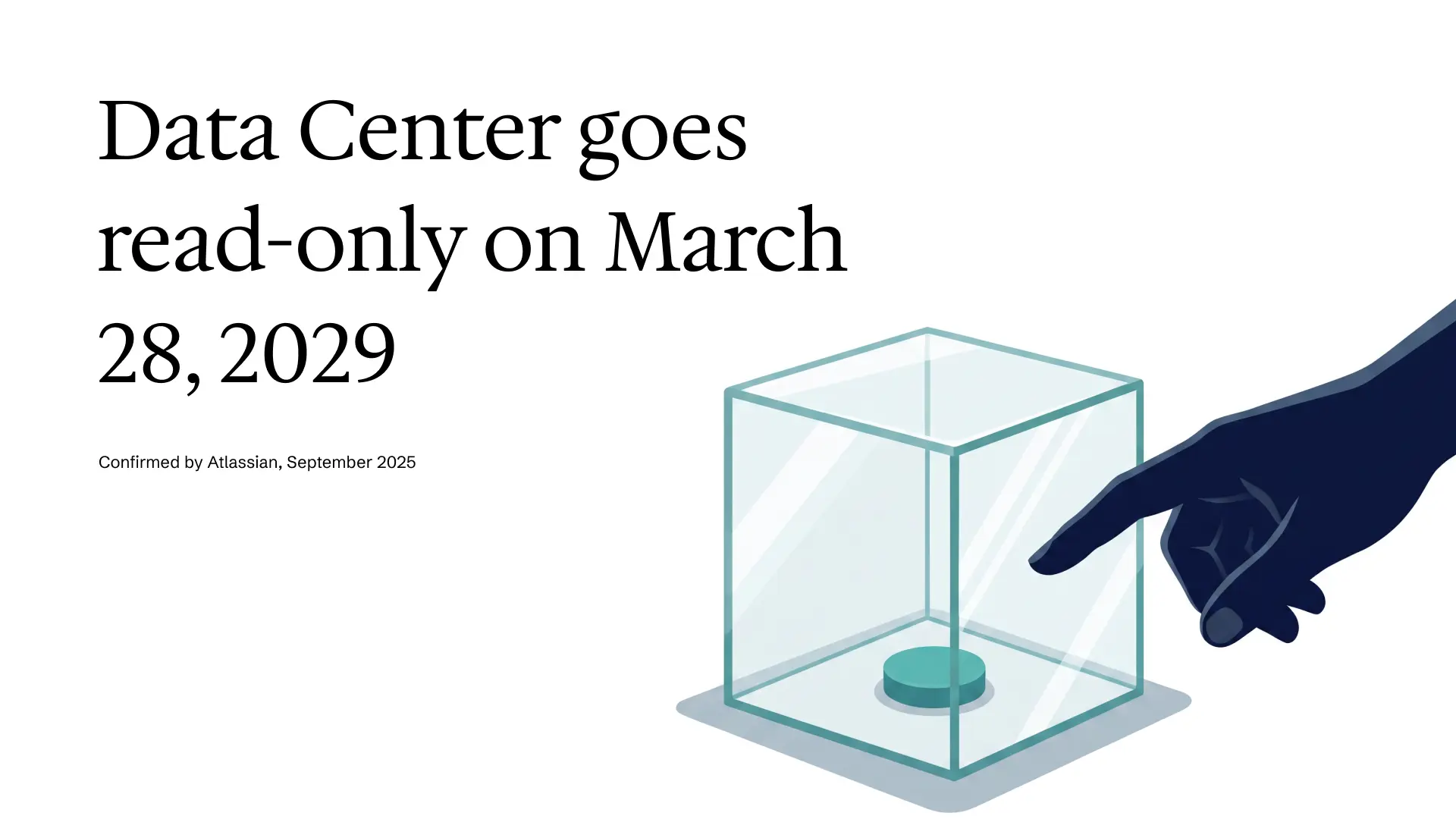


Quick answer: Enterprise software still takes six to twelve months to implement because the way it gets delivered hasn’t changed, even though the software has. Whether the platform is Atlassian, monday.com, or the Microsoft stack, a typical rollout still runs on manual discovery, workshop-based requirements, configuration by hand, and a single high-stakes cutover, a sequence built before AI, context graphs, or modern synchronization existed. The platform itself can be stood up quickly. What stretches into quarters is everything the old delivery model does around it. Contextual Delivery replaces that model, so a rollout that once ran half a year produces a working system teams can test within days.
In the first piece in this series, we named the category, Contextual Delivery, and argued that enterprise delivery is overdue for a rebuild. This is the part where we sit with the symptom everyone in the building actually feels.
The timeline nobody questions anymore
Ask an IT director how long a serious platform rollout takes and you’ll get a version of the same shrug: six months if it goes well, closer to a year if it doesn’t. It barely matters whether the tool is Jira, monday.com, or something in the Microsoft stack, the number lands in roughly the same place, because the slow part was never the software. The industry benchmark for mid-market and enterprise collaboration SaaS runs somewhere between three and eighteen months, and the bigger the organization, the further up that range it sits.
At some point we stopped treating this as a problem to solve and started treating it as weather, something you plan around rather than change. It isn’t weather.
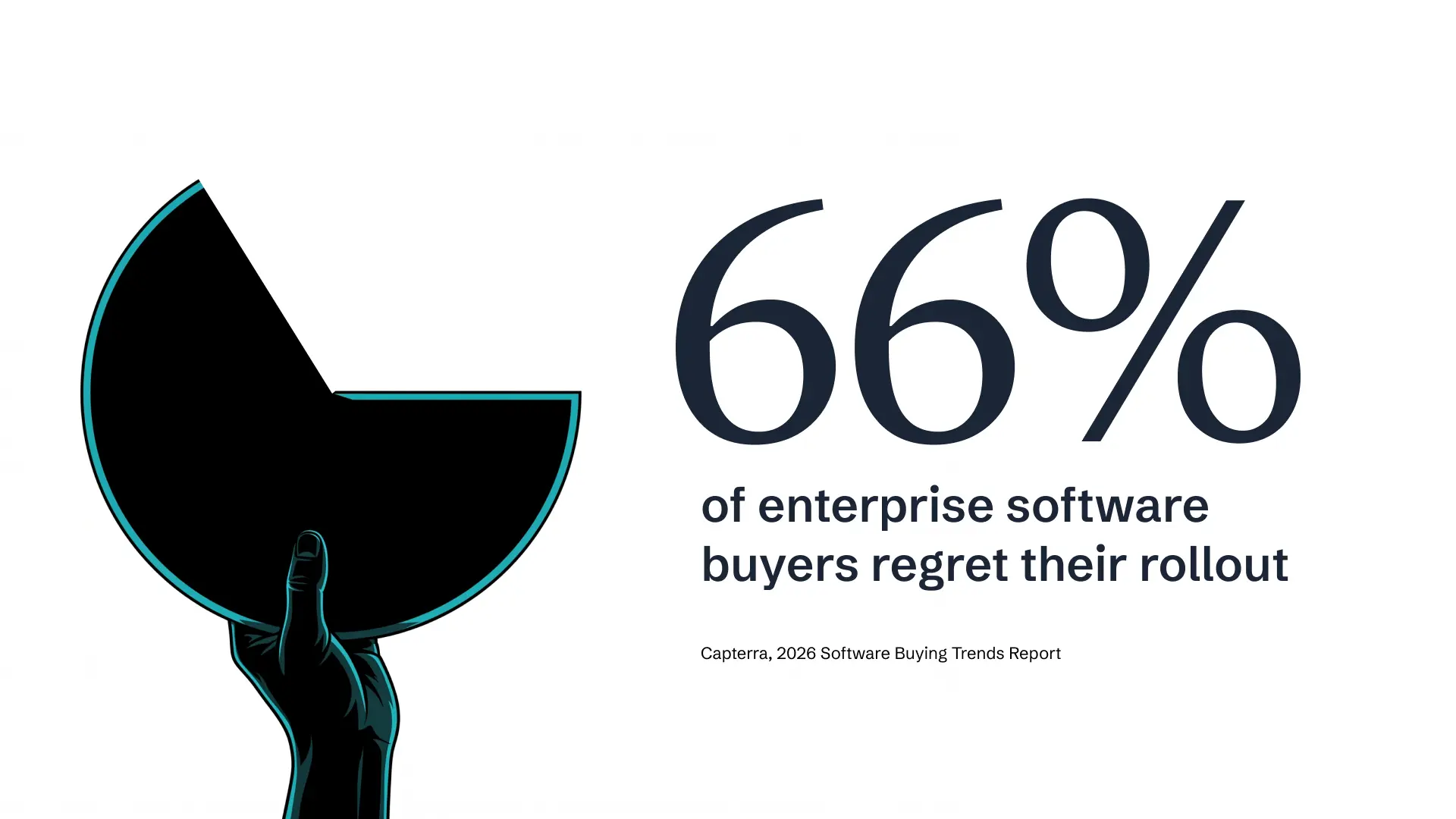
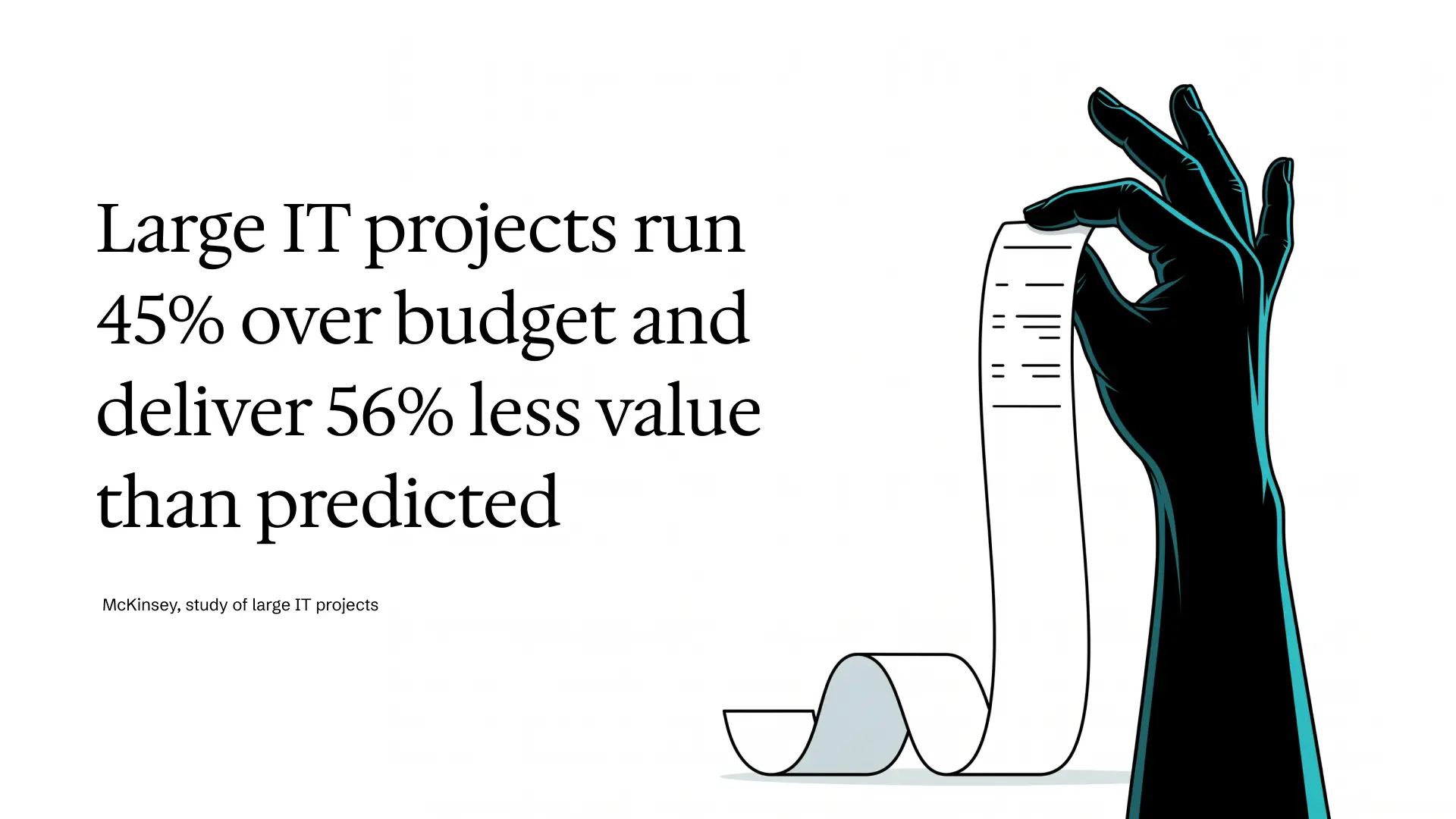
The cost of accepting it is well documented. McKinsey’s study of large IT projects found they run 45% over budget on average and deliver 56% less value than predicted. BCG, across roughly 900 digital transformations, put the success rate at about 30%. And Capterra’s 2026 Software Buying Trends Report (published October 2025) found that only 34% of buyers get through implementation smoothly.
The other 66% run into disruption, regret, or both.
Capterra, 2026 Software Buying Trends Report
And nearly nine in ten of those who regret a purchase first hit a disruption during the rollout rather than a fault in the product they bought.
When the same outcome repeats across thousands of projects, it isn’t bad luck. It’s the model doing exactly what it was built to do.
Where the months actually go
Modern platforms are more capable and more configurable than anything that came before them. So the bottleneck sits upstream of the product, in a way of delivering it that has barely moved in a decade, no matter which ecosystem you’re standing up.
The old model rests on an assumption that rarely holds: that an organization understands its own environment well enough to design an implementation around what gets said in a handful of workshops. In practice, what ends up documented is what people believe to be true, which isn’t always what’s operationally real. That’s not carelessness. Enterprise environments are simply too large and too distributed for any one team to hold in its head. Configuration debt piles up quietly, workflows drift from their documented designs, and dependencies form that nobody ever writes down.
By the time delivery starts, the environment has already moved past the version described in the scope. Everything built after that inherits the gap.
Three reasons implementation still takes months
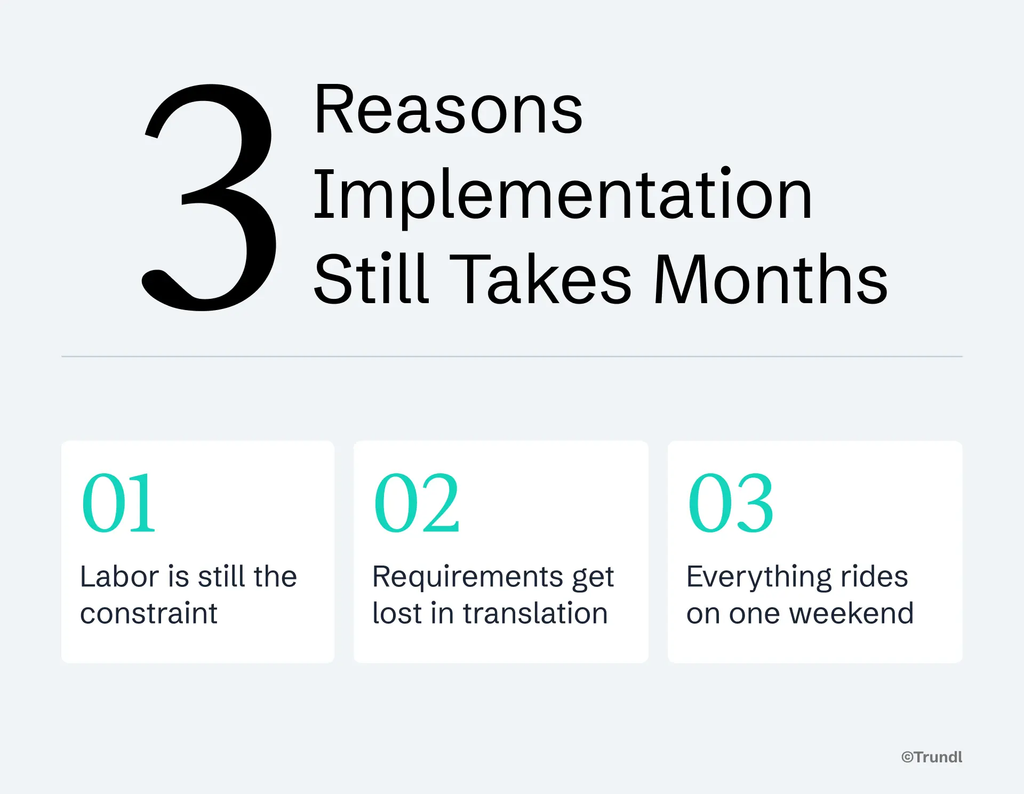
1. Labor is still the constraint. Time-and-materials consulting runs on human interpretation. Someone has to find the documentation, read it, sit through the workshops, coax out the tribal knowledge, square it against whatever leadership has mandated, and turn all of it into a working configuration. Those hours don’t compress the way software does. Add scope and you add people, and the timeline grows with the headcount.
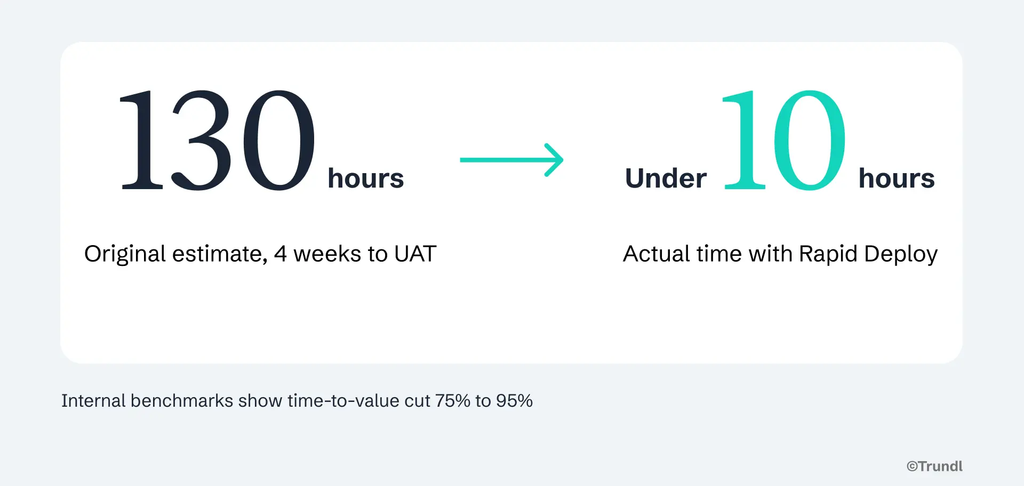
That’s why a faster consultant still hits the same ceiling. Toshiba’s hardware team saw it firsthand: their Jira build was first scoped at 130 hours across four weeks to UAT, not because the work was exotic, but because that’s what two specialists cost when they’re translating requirements into configuration by hand.
2. Requirements get lost in translation. Between “what the business needs” and “what actually gets built” sits a long chain of handoffs, and something leaks at every link. Stakeholders describe what they remember. An analyst documents an interpretation of it. An architect designs against that document. An admin configures against the design. By the time anyone can test the result, weeks or months have passed, and both the requirements and the people who set them have moved on.
People misremember what they asked for. The business shifts underneath them. What finally gets tested is fitted to a company that no longer looks quite like it did at kickoff. That’s the machinery behind that two-thirds who hit disruption or regret: not a bad product, but requirements that were stale before the first field was configured.
3. Everything rides on one weekend. Because the model runs in sequence, the risk collects at the very end. Configuration wraps, data migrates, a change advisory board signs off, and a cutover gets scheduled for a weekend, the night every migration buyer dreads, with IT working through Saturday hoping nothing has broken by Monday. None of it can be validated piece by piece, because the model was never built that way. Each gate is reasonable on its own. Stacked together, they’re what turns a deployment into a six-to-twelve-month project with a white-knuckle finish.
Why AI hasn’t fixed it yet
The obvious question in 2026 is why AI hasn’t already collapsed all of this. The answer is that most organizations have bolted AI onto a process that was never designed to accommodate it. Gartner expects more than 40% of agentic-AI projects to be scrapped by the end of 2027 (Gartner, June 2025), and MIT’s 2025 State of AI in Business report found that 95% of enterprise generative-AI pilots delivered no measurable impact on the bottom line, largely because the workflow underneath, the one the AI is meant to speed up, is still the broken one.
Make a flawed sequence faster and you get a faster flawed sequence.
Real change comes from redrawing the sequence itself, which is a different kind of project than dropping a tool into the existing one.
What actually changes the timeline
Contextual Delivery goes after the causes, not the symptoms. Where the old model relies on manual interpretation, Contextual Delivery uses automated discovery to read the environment as it actually is. Where requirements once traveled through a chain of handoffs, it translates business context and intent straight into deployable configuration. And where the whole thing used to hinge on a single cutover, it validates continuously, putting a working system in front of stakeholders in days, rather than asking them to approve a design on paper and wait for the reveal.
None of that is bound to a single platform. The same logic applies wherever work actually lives, Atlassian, monday.com, or Microsoft, because the constraint it removes is the delivery model, not the tool. Trundl operationalizes it inside the Atlassian ecosystem, as Rapid Deploy, where internal benchmarks show time-to-value on custom enterprise deployments cut by 75% to 95%. Toshiba’s hardware organization is what that looks like in practice. They handed over the work-breakdown documentation they already had and a single stakeholder transcript, and by the second meeting they weren’t reviewing a proposed design. They were working inside a live system that already matched how their teams operated, portfolio rollups and all.
A build first scoped at 130 hours across four weeks was finished in under ten, meeting time included.
For the full definition of the category and its seven core capabilities, see What Is Contextual Delivery? To see what a single working session produces, see What Is a Rapid Deploy Day?
The bottom line
The six-to-twelve-month rollout isn’t a rule of enterprise IT so much as a leftover from a delivery model built around human labor, the one constraint AI has genuinely loosened. As long as delivery leans on manual interpretation, requirements passed down a chain, and all-at-once cutovers, the timeline stays put and the regret rate stays with it. That’s true whether your work lives in Atlassian, monday.com, or Microsoft.
Blog 1 named the category. This one explains why the old model still produces the timelines it does. Contextual Delivery is what breaks the pattern: not the old model run faster, but a different one, where business intent turns into a working system at the speed the business is already moving.
Next in the series: What Is a Rapid Deploy Day? (And What Can You Actually Get Done In One?)