


Quick answer: Contextual Delivery is a new category of enterprise delivery platforms built for the AI era. Contextual Delivery platforms transform fragmented business intent, operational context, and system realities into validated, deployable, continuously evolving systems of work (like Atlassian, monday.com). They combine AI-assisted orchestration, automated discovery, governance-aware automation, and cross-platform synchronization into a single delivery capability. Contextual Delivery is operationalized through seven core capabilities. Trundl’s Rapid Deploy is among the first Contextual Delivery platforms operationalizing the model inside the Atlassian ecosystem.
The end of the implementation era
Inefficiencies around deploying enterprise SaaS have been building for years. McKinsey’s landmark study of large IT projects found they run on average 45% over budget and deliver 56% less value than predicted. BCG’s research across roughly 900 digital transformations found only 30% succeed. Failure is not occasional. It is the base rate.
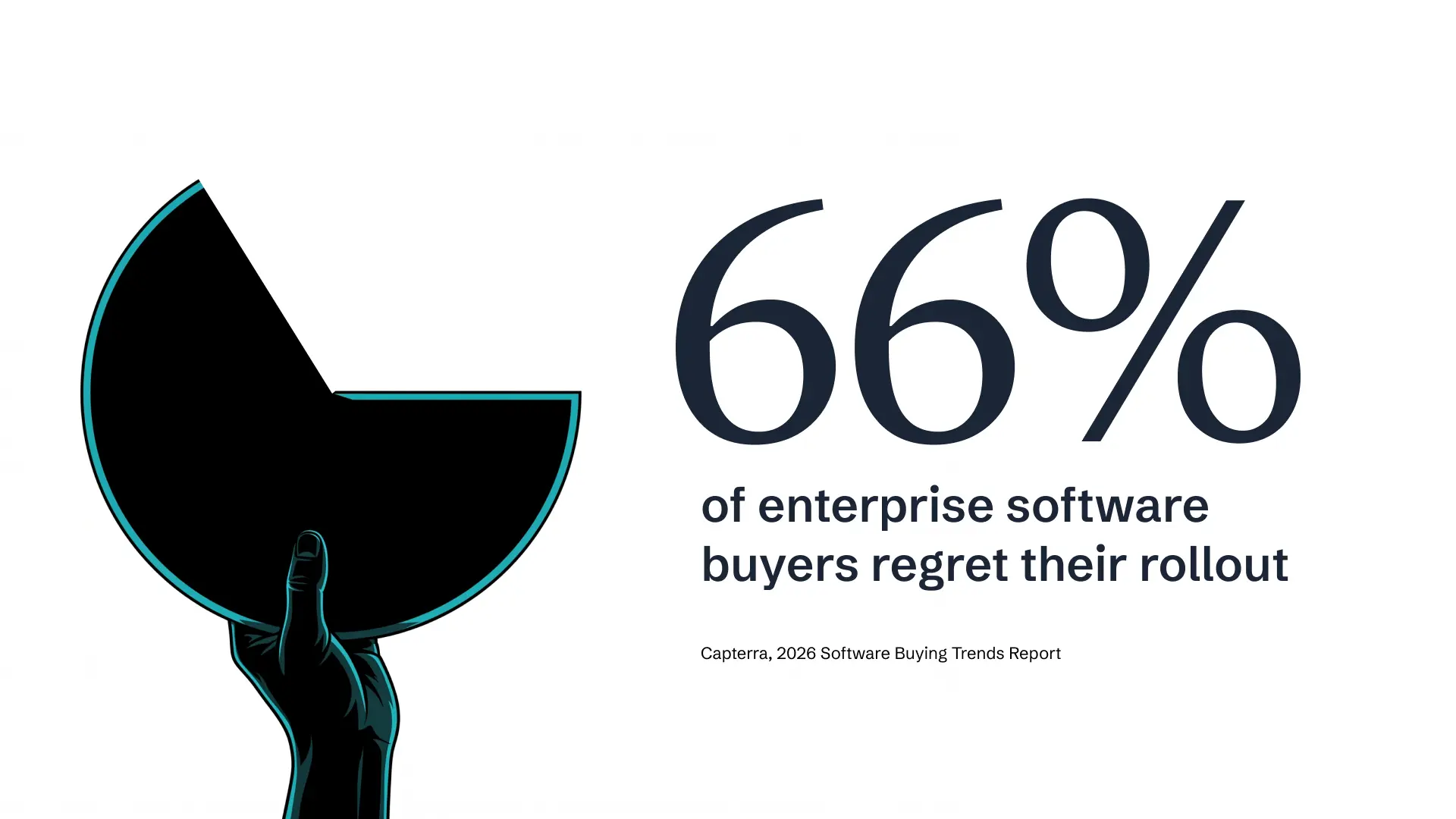
Capterra’s 2026 Software Buying Trends Report (a survey of 3,385 software decision-makers across 11 countries, published October 2025) sharpens this with a pointed number: only 34% of buyers achieve a smooth buying and implementation process.
The other 66% live through unexpected disruption, regret, or both.
Capterra, 2026 Software Buying Trends Report
And nearly nine in ten buyers who regret a purchase first hit an unexpected disruption during the rollout, an integration, migration, or configuration problem, rather than a fault in the product they chose.
This highlights a fundamental problem with legacy enterprise delivery models.
For more than a decade, enterprise software has been deployed using approaches engineered for a world without AI, without context graphs, and without modern synchronization infrastructure. Labor was a binding constraint. Manual interpretation was the default. Weekend cutovers were unavoidable. Governance was a downstream review activity. None of that is still true.
The delivery model, however, has not been updated.
Contextual Delivery is the upgrade companies need to meet the AI era. It is not a faster version of the old model. It is a new operating model entirely.
What is Contextual Delivery?
Contextual Delivery is a category of enterprise delivery platform that transforms business intent, operational context, and system realities into validated, deployable, continuously evolving systems of work.
Where traditional consulting, migration tools, and admin utilities each solve a slice of the delivery problem, Contextual Delivery platforms unify them. They combine AI-assisted orchestration, automated discovery, governance-aware automation, and cross-platform synchronization into a single delivery capability that runs continuously, not in phases.
The category exists because the work of enterprise delivery has fundamentally changed. The question is no longer “can this software be configured?” The question is “can business context be continuously translated into operational reality at enterprise scale?”
Contextual Delivery platforms answer that question by operationalizing delivery itself. They turn delivery from a labor-intensive services activity into a scalable, intelligent, continuously adaptive system.
The four shifts that define Contextual Delivery
Contextual Delivery platforms enable four foundational shifts in how enterprise systems are delivered and run.
| From | To |
| Static implementations | Adaptive systems of work |
| Manual configuration | Context-aware orchestration |
| Human-only delivery | Human-governed AI execution |
| Point-in-time transformation | Continuous operational evolution |
The legacy model is optimized for a constraint, human labor, that AI has fundamentally relaxed. Contextual Delivery platforms are designed for the constraints that actually bind enterprise delivery in 2026: context fragmentation, governance complexity, cross-platform misalignment, and the speed of continuous business change.
Why the legacy model still produces 9-month rollouts
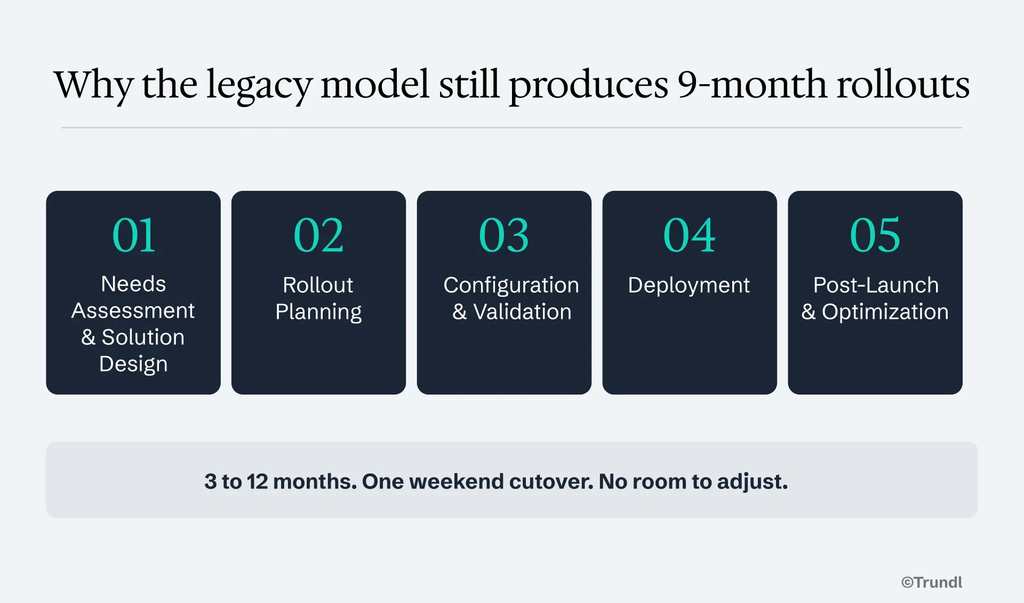
To understand what Contextual Delivery replaces, look at how enterprise platforms still get deployed today. The sequence is essentially the same one diagrammed a decade ago.
Phase 1: Needs Assessment and Solution Design. Business stakeholders surface pain points. An architect maps integrations and produces an impact analysis. Weeks pass.
Phase 2: Rollout Planning. A project manager breaks the work into epics, milestones, and acceptance criteria. A phased schedule is built. More weeks pass.
Phase 3: Configuration and Validation. Admins configure the platform. A pilot group runs UAT. Change Management drafts training materials and obtains sign-off. Months pass.
Phase 4: Deployment. Accounts are provisioned, data is migrated, and the Change Advisory Board approves. A weekend cutover is scheduled.
Phase 5: Post-Launch and Optimization. Issues are triaged. Root cause analyses are filed. Adoption is measured. The platform begins, quietly, to drift.
Every gate is necessary. Every handoff is justified. Every phase is reasonable in isolation. In aggregate, the model produces 3 to 12 month implementations, weekend cutover anxiety, and configurations based on 3-month old business requirements.
This is what 66% of buyers regret. And it is exactly the pattern Contextual Delivery is built to break.
Why AI changes the delivery equation
The argument for Contextual Delivery is not that AI makes consultants faster. It is that AI changes which constraints bind enterprise delivery. Three structural shifts are now underway:
Context graphs are emerging to hold what tribal knowledge used to.
Knowledge graphs map what exists; context graphs aim to capture why decisions were made, the procedural memory that consulting deliverables used to bury in static Word documents nobody reads. The idea is still taking shape, and the field has not fully settled on what to call it or exactly how to build it. But the direction is clear enough that Gartner projects more than half of AI agent systems will use context graphs by 2028. The label matters less than what it enables: institutional logic can increasingly live in the system being deployed rather than in people’s heads. (Worth noting: context graphs are widely described as augmenting knowledge graphs, not replacing them.)
Context engineering replaces prompt engineering.
Gartner predicts that by 2028, context engineering features will be built into 80% of the software tools used to build AI applications, and that context engineering improvements will enhance agentic-AI accuracy by at least 30%. Context engineering is the discipline of designing the entire information environment an agent operates within. In delivery terms, it is the difference between handing a configuration to an admin and handing the platform the room, the tools, and the memory to configure itself correctly the first time.
Gartner’s August 2025 forecast projects that 40% of enterprise applications will embed task-specific AI agents by the end of 2026, up from less than 5% in 2025, which means the operational infrastructure to support this shift needs to exist now, not two years from now.
Proof comes first, not last.
MIT’s 2025 State of AI in Business report (Project NANDA) found that 95% of enterprise generative-AI pilots delivered no measurable P&L impact, and its authors are clear the failure is usually organizational, not technical. Gartner expects more than 40% of agentic-AI projects to be canceled by the end of 2027. In both cases the cause is the same: organizations bolt AI onto workflows that were never designed for it. Contextual Delivery’s premise is to redesign the workflow and the operational context first. That is what lets Trundl commit to a proof-first delivery model, connecting to real data and putting a working, testable system in front of stakeholders in days rather than quarters. (This one is Trundl’s own delivery commitment, not an industry statistic.) Every month a deployment spends in pre-production is a month of lost institutional learning.
These shifts are already underway in the industry data, and Contextual Delivery is built to operationalize them.
The 7 core capabilities of a Contextual Delivery platform
A Contextual Delivery platform is not a faster consultant. It is a unified delivery capability. Seven core capabilities define what makes a platform Contextual Delivery-class, and they map directly to the failure points of the legacy model.
- Context Translation. Contextual Delivery platforms transform business intent into deployable operational systems. They convert organizational workflows into structured configurations, translate policies into governance-aligned implementations, and preserve business context throughout the delivery lifecycle. Activation can happen through AI-readable transcripts of meetings and conversations on Loom, Slack, Zoom, and Teams. Business context becomes the raw material of configuration, not the lossy input to a consultant’s interpretation.
- Automated Discovery. Contextual Delivery platforms continuously analyze enterprise environments to uncover operational realities that traditional implementations miss. Structural analysis, dependency mapping, configuration intelligence, and usage pattern analysis create evolving operational awareness directly from the systems themselves. Discovery replaces assumption-based delivery with evidence-based transformation.
- AI-Assisted Workflow Reimagination. Contextual Delivery platforms use human-governed AI to interpret intent, recommend operational improvements, generate validated configurations, and accelerate workflow modernization. The human remains in control. The AI amplifies delivery speed, consistency, and scalability without becoming the decision-maker.
- Platform Syncs. Modern enterprises operate across interconnected platforms, tools, and data ecosystems. Contextual Delivery platforms establish synchronized operational context across environments through intelligent platform connectivity. Shared progress visibility, shared delivery context, cross-platform consistency, and aligned operational states give organizations a unified understanding of work even when execution lives in disparate systems.
- Governance-Aware Automation. Contextual Delivery platforms embed governance directly into delivery acceleration. Compliance-aware deployment patterns, auditability preservation, change management integrity, and security-conscious automation are baked into the platform. Governance stops being a downstream review activity and becomes an integrated component of delivery itself.
- Iterative Validation & Refinement. Contextual Delivery platforms enable continuous realization and validation rather than phase-heavy deployments. Organizations validate earlier, adapt continuously, reduce implementation risk, and incorporate evolving business priorities dynamically. Delivery becomes evolutionary rather than linear.
- Repeatable Operating Models. Contextual Delivery platforms standardize and operationalize delivery knowledge. Reusable delivery frameworks, scalable deployment methodologies, repeatable governance models, and institutionalized best practices let organizations scale outcomes without scaling headcount. This is what makes Contextual Delivery economics fundamentally different from consulting economics.
Together, these seven capabilities define a unified enterprise delivery capability. They are not features on a roadmap. They are the operating definition of the category.
How Contextual Delivery compares to adjacent categories
Existing categories solve isolated portions of the delivery problem. Contextual Delivery is the first to unify them.
| Category | Primary focus | Limitation |
| Traditional Solution Partners and MSPs | Advisory and manual configuration | Labor-intensive and difficult to scale |
| Migration Tools | Data movement | Does not solve operational design or adoption |
| Script and Admin Utilities | Task acceleration | Lacks orchestration and governance |
| AI Coding Assistants | Developer productivity | Missing enterprise delivery coordination |
| Integration Platforms | System connectivity | Do not orchestrate delivery outcomes |
| Contextual Delivery Platforms | Unified, context-driven, AI-assisted enterprise delivery | Replaces all of the above as a category |
The economic shift is direct. Legacy models depend on effort-based delivery economics. Contextual Delivery platforms enable intelligence-driven delivery economics.
Why now: the convergence of forces
Six forces are converging to make Contextual Delivery necessary, not optional.
AI maturity. AI can now meaningfully interpret operational context and intent and translate them into structured configurations, workflows, and recommendations. It is no longer limited to generating content. Gartner’s August 2025 forecast projects that 40% of enterprise applications will embed task-specific AI agents by the end of 2026, up from less than 5% in 2025. The shift is not coming. It is already underway.
Enterprise complexity. Modern enterprise environments have passed the scale where manual configuration and isolated delivery approaches remain sustainable.
Demand for speed. Organizations can no longer tolerate multi-quarter implementation cycles to modernize operational systems.
Hybrid tool ecosystems. Enterprises increasingly operate across fragmented platforms and disconnected operational data sources. Synchronized systems of work are now a prerequisite, not an aspiration.
Continuous transformation. Transformation is no longer episodic. Enterprises now exist in a state of perpetual operational evolution, and the delivery model must match.
Governance pressure. Organizations must modernize while simultaneously improving compliance, auditability, and operational control. Bolted-on governance no longer keeps up.
The combination of these forces makes the old model untenable. The combination of AI capability and enterprise need makes Contextual Delivery inevitable.
Trundl, Rapid Deploy, and the Atlassian opportunity
Trundl is among the first organizations operationalizing the Contextual Delivery model, and among the first to do so inside the Atlassian ecosystem through Rapid Deploy.
Atlassian is uniquely positioned to become the foundational platform ecosystem for Contextual Delivery. Unlike traditional enterprise platforms, Atlassian sits at the intersection of:
- Work management and execution
- Knowledge and collaboration
- Extensibility and ecosystem scale
- AI-enabled teamwork
- The Teamwork Graph as a connected operational data layer
That makes Atlassian not just a place where work happens. It makes Atlassian the substrate on which intelligent systems of work can be built.
The full value of that position, however, remains constrained by legacy delivery approaches that still depend on manual interpretation, sequential implementation models, and slow configuration cycles.
Rapid Deploy is Trundl’s answer to that constraint. It operationalizes the seven Contextual Delivery capabilities for Atlassian customers and turns the Teamwork Graph from a feature into an operating layer.
Contextual Delivery unlocks the next phase of Atlassian’s evolution:
- From tools to context-aware operational systems
- From static implementations to adaptive systems of work
- From fragmented delivery to synchronized operational ecosystems
- From configuration-heavy engagements to intelligent orchestration
- From partner-led scaling to platform-accelerated scale
What Rapid Deploy actually looks like
Rapid Deploy is the moment when Contextual Delivery stops being theoretical, and starts being applied to real use cases.
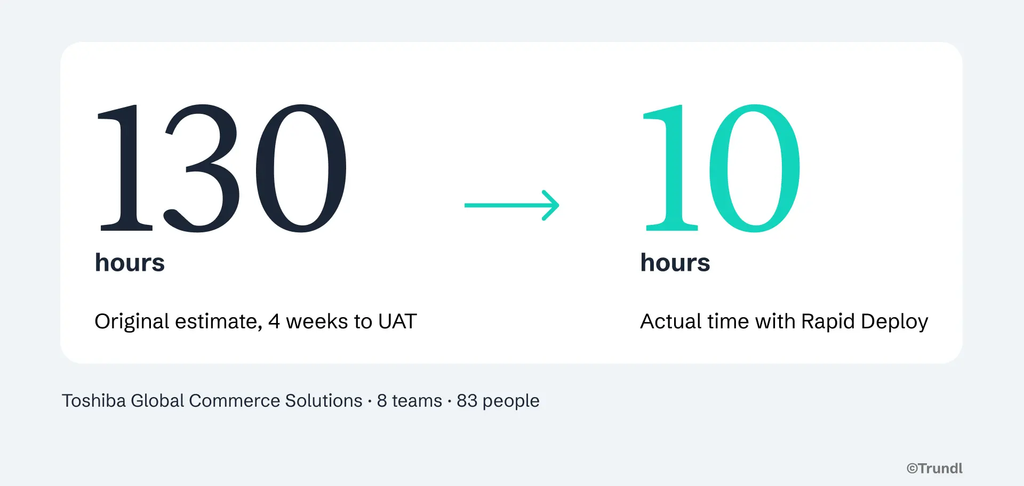
Toshiba Global Commerce Solutions needed to move its hardware organization, eight teams, 83 people, off Smartsheet and into its corporate Jira, preserving existing structures, naming, and workflows with minimal retraining. Under the legacy model, that was a 130-hour engagement with four weeks to UAT. Instead, Toshiba handed Trundl its existing work-breakdown documentation and a stakeholder meeting transcript, and Rapid Deploy turned them directly into a working Jira instance in the sandbox.
By the second meeting, Toshiba’s teams weren’t reviewing a proposed design. They were testing a live system that already mirrored how they worked, with portfolio rollups from day one. The 130-hour, four-week estimate was completed in under 10 hours including meeting time: days instead of months to an enterprise-grade Jira environment, with the incompatible legacy tool retired.
Toshiba’s 60-page Smartsheet export became a working Jira instance in two Rapid Deploy sessions.
Toshiba Global Commerce Solutions, 8 teams, 83 people
That is the experience the entire Contextual Delivery model is engineered to produce, and it is the proof point that turns the Contextual Delivery category from a thesis into a thing you can book.
What Contextual Delivery enables, in numbers
Organizations operating on Contextual Delivery platforms see measurable operational advantages:
- Delivery timelines shrink from months to days
- Migration rework and delta cycles drop
- Cloud modernization accelerates
- Enterprise service activation speeds up
- Operational friction decreases
- Governance traceability improves
- Delivery risk goes down
- Organizational adaptability goes up
- Cross-platform alignment strengthens
- Dependence on manual configuration effort falls away
The most important outcome is the one that compounds. Contextual Delivery enables enterprises to continuously evolve their systems of work as business conditions change, instead of paying for episodic transformation projects that age out within two years.
The Bottom Line
McKinsey and BCG put the cost of the old model into hard numbers. MIT and Gartner put the cost of bolting AI onto broken workflows into equally hard numbers. The demand is not hypothetical, companies are already spending enormous sums trying to modernize and adopt AI, and most of that spend is underperforming. Contextual Delivery is how it pays off.
That is what Contextual Delivery is. That is the shift Trundl is operationalizing. And 2026 is the year enterprise IT stops paying for the old model.
The category is named. The capabilities are defined. Rapid Deploy is the door.
No 9-month timeline. No weekend cutover. No regret.
Ready to see Contextual Delivery on your environment? Book a Rapid Deploy session and end it with a configured, working Atlassian platform.
Next in the series: Why Does Enterprise Software Implementation Still Take 6 to 12 Months in the Age of AI?